ACG2071 Chapter 8 (Principles of Managerial Accounting)
Diese Karteikarten lernenKostenlos · Spaced Repetition · iPhone, Android, Mac & Web
Alle Karten
1
Budget performance report
(What is the definition?)
(What is the definition?)
"A budget performance report is a report that summarizes the actual results, budgeted amounts, and the differences."
2
Variance
(What is the definition of this word in terms of budgeting?)
(What is the definition of this word in terms of budgeting?)
A variance is the difference between an actual amount and the budgeted amount.
Variances can be either favorable or unfavorable as follows in the image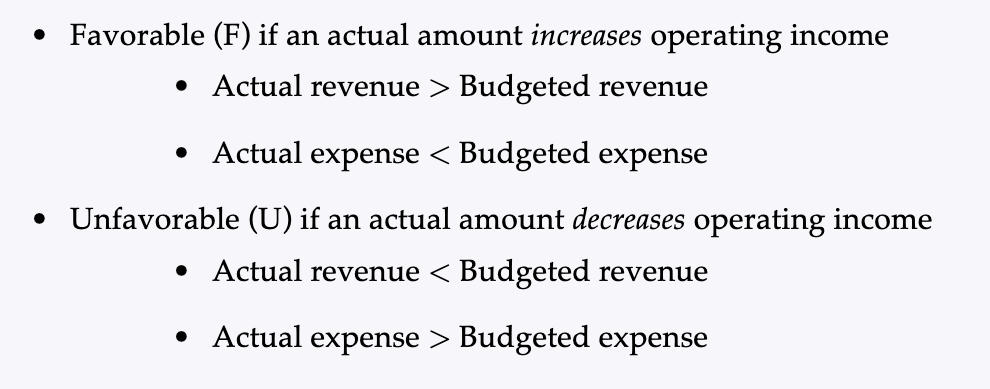
Variances can be either favorable or unfavorable as follows in the image
3
*F is fortunate variance
*U is Unfortunate Variance
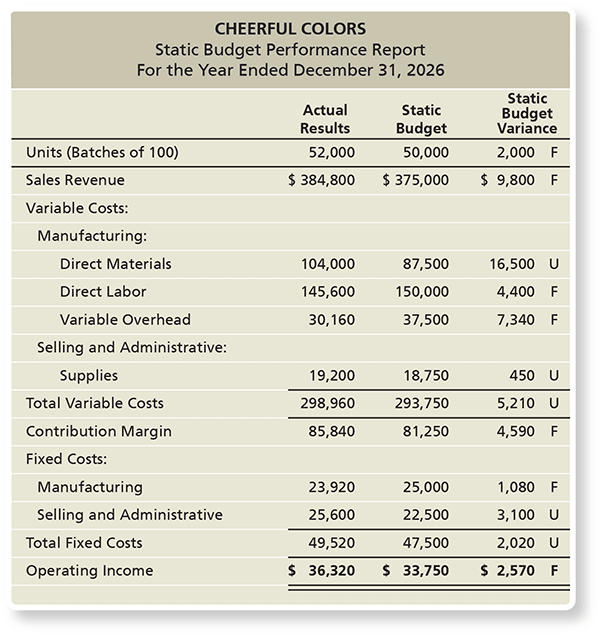
Static Budget Performance Report
*F is fortunate variance
*U is Unfortunate Variance
4
Flexible Budget
A flexible budget summarizes revenues and expenses for various levels of sales volume. Variable costs change within a flexible budget, but Fixed costs DO NOT.
*The image shows a flexible budget for 48,000, 50,000 & 52,000 units. The budgeted sales per unit is \$7,50,
(To help better understand if your brain dead)"Budgeted variable costs are \$1.75 for direct materials, \$3.00 for direct labor, \$0.75 for variable manufacturing overhead, and 5% of sales revenue for selling and administrative supplies. Budgeted fixed costs are \\$25,000 for manufacturing overhead and \$22,500 for selling and administrative."
*The image shows a flexible budget for 48,000, 50,000 & 52,000 units. The budgeted sales per unit is \$7,50,
(To help better understand if your brain dead)"Budgeted variable costs are \$1.75 for direct materials, \$3.00 for direct labor, \$0.75 for variable manufacturing overhead, and 5% of sales revenue for selling and administrative supplies. Budgeted fixed costs are \\$25,000 for manufacturing overhead and \$22,500 for selling and administrative."
5
Flexible Budget Variance: The difference between the expected results in the flexible budget for the actual units sold and the actual results
Sales Volume Variance: The difference between the expected results in the flexible budget for the actual units sold and the static expected results .
*"the expected results in the flexible budget for the actual units sold" is using the actual units sold with the expected costs and sales.
Flexible Budget Variance:
Sales Volume Variance:
Sales Volume Variance:
Flexible Budget Variance: The difference between the expected results in the flexible budget for the actual units sold and the actual results
Sales Volume Variance: The difference between the expected results in the flexible budget for the actual units sold and the static expected results .
*"the expected results in the flexible budget for the actual units sold" is using the actual units sold with the expected costs and sales.
6
Flexible Budget Performance Report
The left is the Actual Compared to the flexible budget (using the amount actual sold but expected costs and revenues per unit){Flexible budget Variance}
The right is the Flexible budget (using the amount actual sold but expected costs and revenues per unit) compared to the static budget (originally expected, using expected units sold, unit cost and revenues). {Sales Volume Variance}
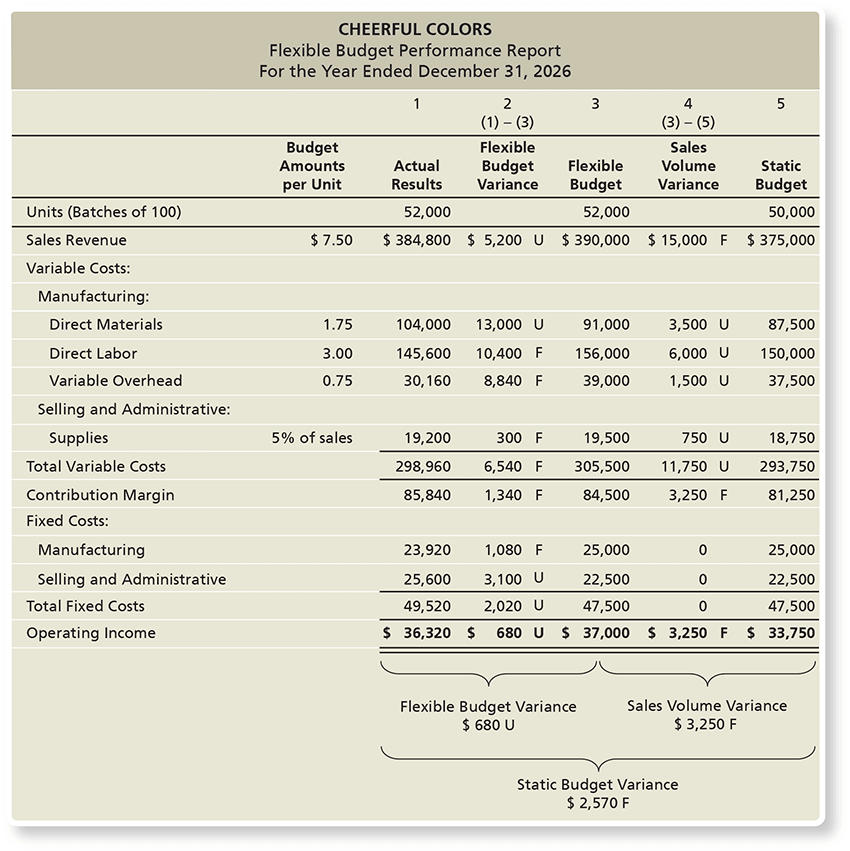
The right is the Flexible budget (using the amount actual sold but expected costs and revenues per unit) compared to the static budget (originally expected, using expected units sold, unit cost and revenues). {Sales Volume Variance}
7
1. Standard
(What is its definition in terms of budgeting?)
2. Also, how does the term "standard" relate to the word "budget"
(What is its definition in terms of budgeting?)
2. Also, how does the term "standard" relate to the word "budget"
1. "A standard is the price, cost, or quantity that is expected under normal conditions."
2. "However, a budget amount generally indicates a total amount, whereas a standard amount is a per unit amount. In the case of direct materials, the standard is \$1.75 per batch, and the budgeted amount for 52,000 batches is \$91,000"
2. "However, a budget amount generally indicates a total amount, whereas a standard amount is a per unit amount. In the case of direct materials, the standard is \$1.75 per batch, and the budgeted amount for 52,000 batches is \$91,000"
8
Standard Cost System
(Define)
(Define)
A standard cost system is an accounting system that uses standards for product costs—direct materials, direct labor, and manufacturing overhead.
9
1. Costing Standards are how much it costs, while efficiency standards are how efficiently it is used.
2. Who is responsible is shown in the image.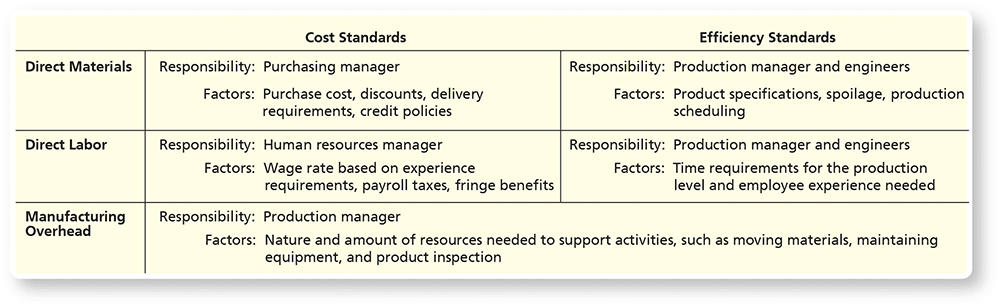
1. Costing Standards vs efficiency standards.
2. Also, who is responsible for the costing and efficiency standards for direct materials, direct labor and manufacturing overhead.
2. Also, who is responsible for the costing and efficiency standards for direct materials, direct labor and manufacturing overhead.
1. Costing Standards are how much it costs, while efficiency standards are how efficiently it is used.
2. Who is responsible is shown in the image.
10
"The company must invest up front to develop the standards, and the standards must be updated on a regular basis—at least once per year."
What is the main issue with standard costing?
"The company must invest up front to develop the standards, and the standards must be updated on a regular basis—at least once per year."
11
Cost Variance
(Its definition and formula)
(Its definition and formula)
A cost variance measures how well the business keeps unit costs of material and labor inputs within standards.
Formula:
(Actual Cost per Unit - Standard Cost per Unit) x Actual quantity
*(NOT NEEDED INFO)The image shows how theyI got to this formula (PS: In the image "Actual Cost" and "Standard Cost" are per unit, NOT total)
Formula:
(Actual Cost per Unit - Standard Cost per Unit) x Actual quantity
*(NOT NEEDED INFO)The image shows how theyI got to this formula (PS: In the image "Actual Cost" and "Standard Cost" are per unit, NOT total)
12
Efficiency Variance
(Its definition and formula)
(Its definition and formula)
"An efficiency variance measures how well the business uses its materials or human resources."
Formula:
(Actual quantity of input used -Standard quantity of input allowed for the actual number of units produced) x Standard cost per unit of input
PS: "Actual quantity of input used" means the amount of input that was actually consumed in production during the period. So, materials sitting in inventory do NOT count.
PS: "Standard quantity of input allowed for the actual number of units produced" means the amount of materials & labor that should have been used for the actual number of units produced.
ex)
Each chair should require 3kg of wood.
They produce more than expected, at a total of 1,500 chairs.
1,500 x 3 = 4,500 kg that should have been used. This is the "Standard quantity of input allowed for the actual number of units produced"
On the other hand, the actual quantity used is 5,000 kg. This is the "Actual quantity of input used" .
Formula:
(Actual quantity of input used -Standard quantity of input allowed for the actual number of units produced) x Standard cost per unit of input
PS: "Actual quantity of input used" means the amount of input that was actually consumed in production during the period. So, materials sitting in inventory do NOT count.
PS: "Standard quantity of input allowed for the actual number of units produced" means the amount of materials & labor that should have been used for the actual number of units produced.
ex)
Each chair should require 3kg of wood.
They produce more than expected, at a total of 1,500 chairs.
1,500 x 3 = 4,500 kg that should have been used. This is the "Standard quantity of input allowed for the actual number of units produced"
On the other hand, the actual quantity used is 5,000 kg. This is the "Actual quantity of input used" .
13
Diagram showing the relationship between the different types of variances we learned.
Expalin them.
Expalin them.
*The reason Cost Variance and Efficiency Variance is under Flexible Budget Variance is because Cost Variance focuses on the differences in cost between actual results and flexible budget, while Efficiency Variance focuses on the difference in efficiency between actual results and flexible budget.
Combining both Cost Variance and Efficiency Variance makes Flexible Budget variance.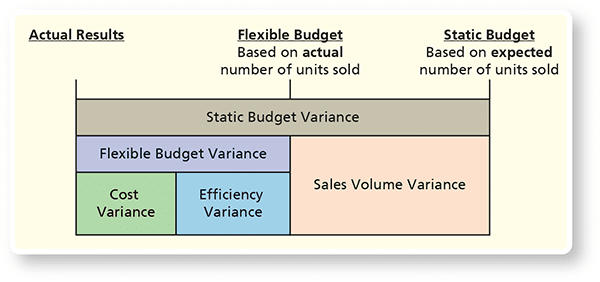
Combining both Cost Variance and Efficiency Variance makes Flexible Budget variance.
14
Direct Materials Cost Variance
"Measures the difference between the amount actually paid for direct materials (actual cost) and the amount that should have been paid (standard cost)."
Formula: (Same as Cost Variance Formula)
(Actual Cost per Unit - Standard Cost per Unit) x Actual quantity
Formula: (Same as Cost Variance Formula)
(Actual Cost per Unit - Standard Cost per Unit) x Actual quantity
15
Direct Materials Efficiency Variance
"measures the difference between the direct materials actually used (actual quantity) and the direct materials that should have been used for the actual output (standard quantity allowed)."
Formula: (Same as Efficiency Variance Formula)
(Actual quantity of input used -Standard quantity of input allowed for the actual number of units produced) x Standard cost per unit of input
Ex)
-The standard quantity that should have been used for the actual number units produced is 260,000
-The amount actually used is 325,000
-Direct Materials cost standard: \$0.35
(325,000 - 260,000) x 0.35 =
\$22,750 U is the Direct Materials Efficiency Variance
*It is unfavorable since they used more materials than expected.
Formula: (Same as Efficiency Variance Formula)
(Actual quantity of input used -Standard quantity of input allowed for the actual number of units produced) x Standard cost per unit of input
Ex)
-The standard quantity that should have been used for the actual number units produced is 260,000
-The amount actually used is 325,000
-Direct Materials cost standard: \$0.35
(325,000 - 260,000) x 0.35 =
\$22,750 U is the Direct Materials Efficiency Variance
*It is unfavorable since they used more materials than expected.
16
If Cost Variance is Favorable and Efficiency Variance is unfavorable, then you would subtract them.
If they were both favorable or unfavorable, then you would just add them.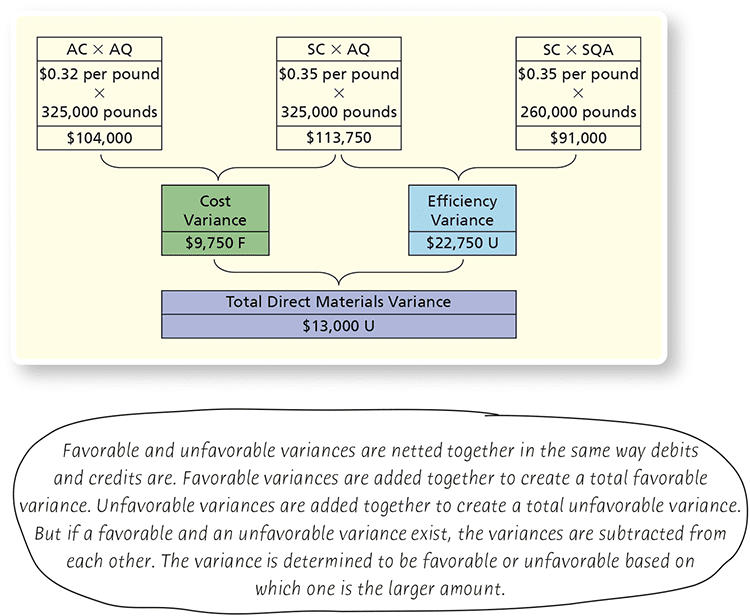
How to use Cost Variance and Efficiency Variance to calculate Total Direct Material Variance
If Cost Variance is Favorable and Efficiency Variance is unfavorable, then you would subtract them.
If they were both favorable or unfavorable, then you would just add them.
17
Is solving for the Direct Labor Variance similar to solving for the direct material variance?
YES, It is the exact same.
For the past 3 slides, just replace the word Direct Material with Direct labor.
For the past 3 slides, just replace the word Direct Material with Direct labor.
18
In a standard cost system, the manufacturing overhead allocated to production is calculated as follows:
*The "Standard overhead allocation rate" is a per-unit rate.
*In a standard cost system, the standard overhead allocation rate replaces the predetermined overhead allocation rate
*In a standard cost system, the standard overhead allocation rate replaces the predetermined overhead allocation rate
19
Standard Overhead Allocation Rate
(How to calculate it?)
(How to calculate it?)
1. Find the budgeted overhead allocation base:
ex) We choose to use direct labor hours as the allocation base
We expect to produce 50,000 units, and each unit requires (according to the direct labor efficiency standard) 0.25 direct labor hours. The budgeted allocation base is 12,500 DLHr (50,000 x 0.25).
2. Find the budgeted variable overhead costs and fixed overhead costs.
ex) In this case, the budgeted variable overhead is \$37,500 and the budgeted fixed overhead is \$25,000.
3. *Look at the Image*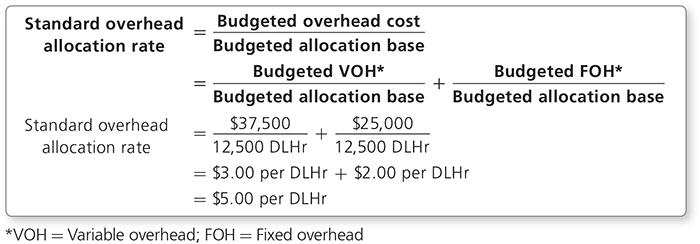
ex) We choose to use direct labor hours as the allocation base
We expect to produce 50,000 units, and each unit requires (according to the direct labor efficiency standard) 0.25 direct labor hours. The budgeted allocation base is 12,500 DLHr (50,000 x 0.25).
2. Find the budgeted variable overhead costs and fixed overhead costs.
ex) In this case, the budgeted variable overhead is \$37,500 and the budgeted fixed overhead is \$25,000.
3. *Look at the Image*
20
Variable Overhead Variances
(Honestly, just like direct material variances)
1. Variable Overhead Cost Variance
Formula:
(Actual Cost per Unit - Standard Cost per Unit) x Actual quantity
*PS: For the actual cost per unit part, you might need to get the total actual cost / total actual amount of direct labor hours (allocation base)
2. Variable Overhead Efficiency Variance
Formula:
(Actual quantity of input used -Standard quantity of input allowed for the actual number of units produced) x Standard cost per unit of input
*PS: For the "Standard quantity of input (direct labor hours in this case) allowed for the actual number of units produced", to get the total standard quantity of direct labor hours, you might need to get the total standard (expected) amount of units to be made x the standard (expected) amount of direct labor hours per unit.
3. Combine the Cost Variance and Efficiency Variance. If they are both fortunate or Unfortunate, then you can add both of those variances. If they are different, then you subtract them. *This is shown in the image*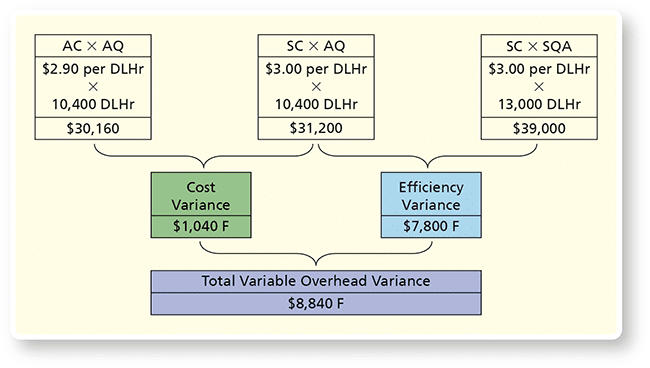
1. Variable Overhead Cost Variance
Formula:
(Actual Cost per Unit - Standard Cost per Unit) x Actual quantity
*PS: For the actual cost per unit part, you might need to get the total actual cost / total actual amount of direct labor hours (allocation base)
2. Variable Overhead Efficiency Variance
Formula:
(Actual quantity of input used -Standard quantity of input allowed for the actual number of units produced) x Standard cost per unit of input
*PS: For the "Standard quantity of input (direct labor hours in this case) allowed for the actual number of units produced", to get the total standard quantity of direct labor hours, you might need to get the total standard (expected) amount of units to be made x the standard (expected) amount of direct labor hours per unit.
3. Combine the Cost Variance and Efficiency Variance. If they are both fortunate or Unfortunate, then you can add both of those variances. If they are different, then you subtract them. *This is shown in the image*
21
Fixed Overhead Variances
(Slide 1/2)
(Noticeably different compared to Direct Materials, Direct Labor and Variable Overhead Variances)
1. Fixed Overhead Cost Variances
Formula:
Actual Fixed Overhead - Budget fixed Overhead
Literally just subtract from one another.
(PS: I tried to find a formula for "actual fixed overhead", but it is literally just the actual amount spent on fixed overhead)
2. Fixed Overhead Volume Variances
*In Image*
-Budgeted Fixed Overhead: The total fixed manufacturing overhead that was planned for the period. (This is based on the expected amount of units produced)(Budgeted (expected) production x Standard fixed overhead rate)
-Allocated Fixed Overhead: The amount of fixed overhead assigned to the units actually produced. (Actual production x Standard fixed overhead rate)
3. Next Slide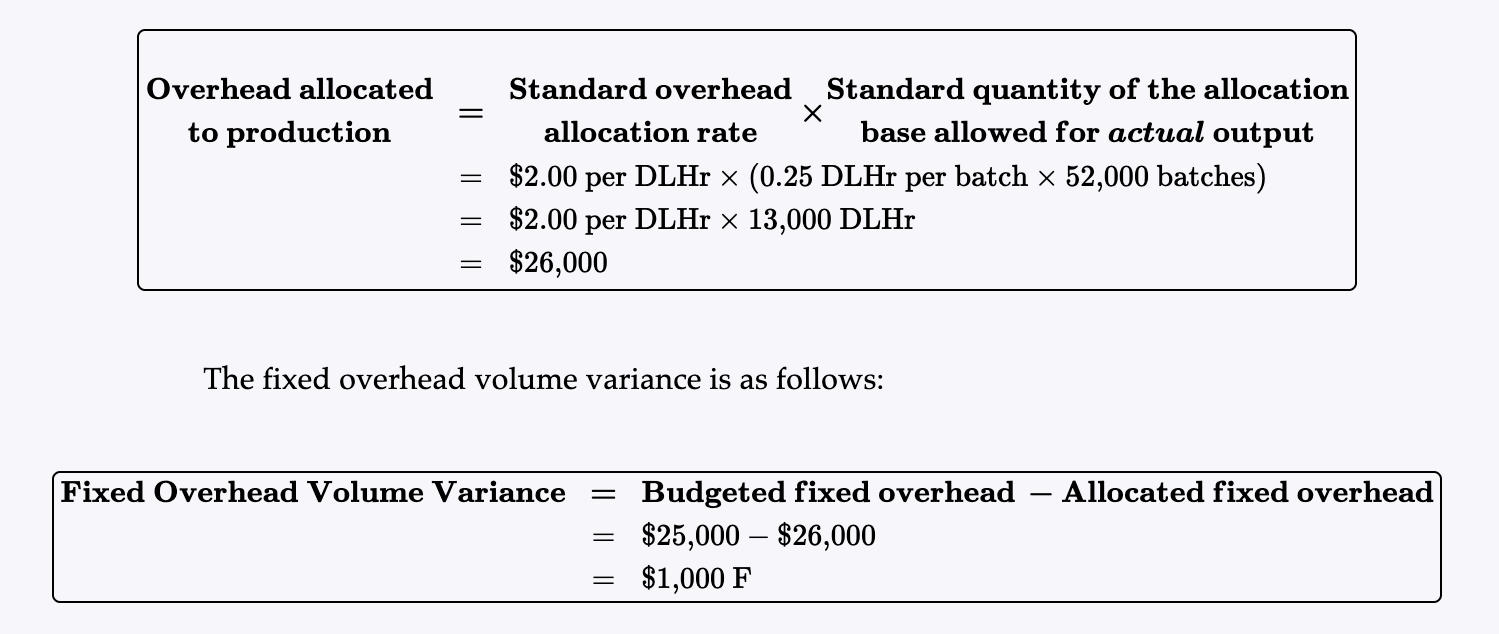
Fixed Overhead Variances
(Slide 1/2)
(Slide 1/2)
Fixed Overhead Variances
(Slide 1/2)
(Noticeably different compared to Direct Materials, Direct Labor and Variable Overhead Variances)
1. Fixed Overhead Cost Variances
Formula:
Actual Fixed Overhead - Budget fixed Overhead
Literally just subtract from one another.
(PS: I tried to find a formula for "actual fixed overhead", but it is literally just the actual amount spent on fixed overhead)
2. Fixed Overhead Volume Variances
*In Image*
-Budgeted Fixed Overhead: The total fixed manufacturing overhead that was planned for the period. (This is based on the expected amount of units produced)(Budgeted (expected) production x Standard fixed overhead rate)
-Allocated Fixed Overhead: The amount of fixed overhead assigned to the units actually produced. (Actual production x Standard fixed overhead rate)
3. Next Slide
22
Fixed Overhead Variances
(Slide 2/2)
(Slide 2/2)
3. Combine the Cost Variance and Volume Variance. If they are both fortunate or Unfortunate, then you can add both of those variances. If they are different, then you subtract them. *This is shown in the image*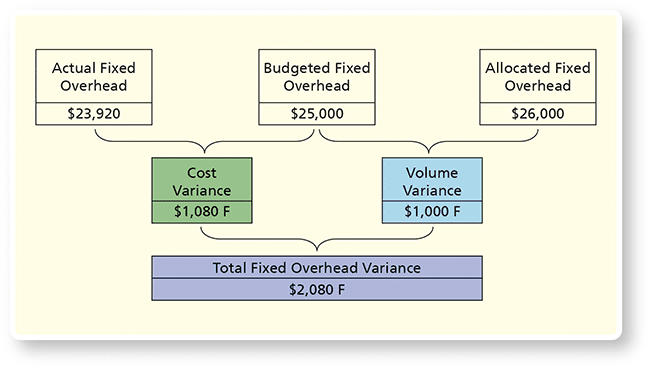
23
Product Cots Variance Relationship Diagram
*Notice how Fixed Overhead Volume Variance is not here. That variance is NOT a flexible budget variance, but a volume variance.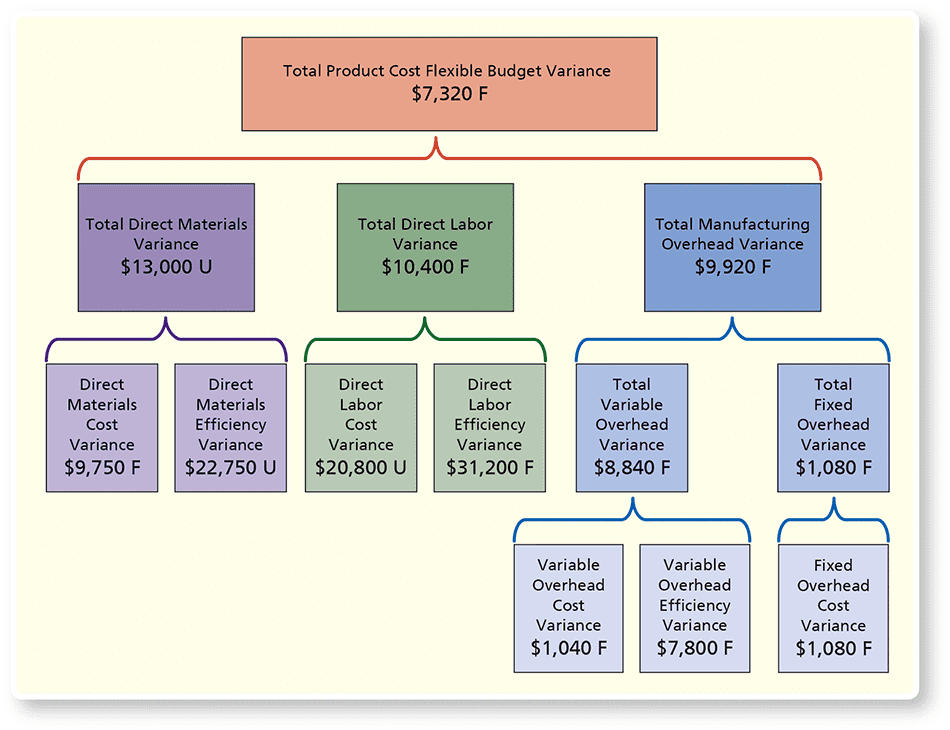
24
Management by Exception
"When managers concentrate on results that are outside the accepted parameters."
25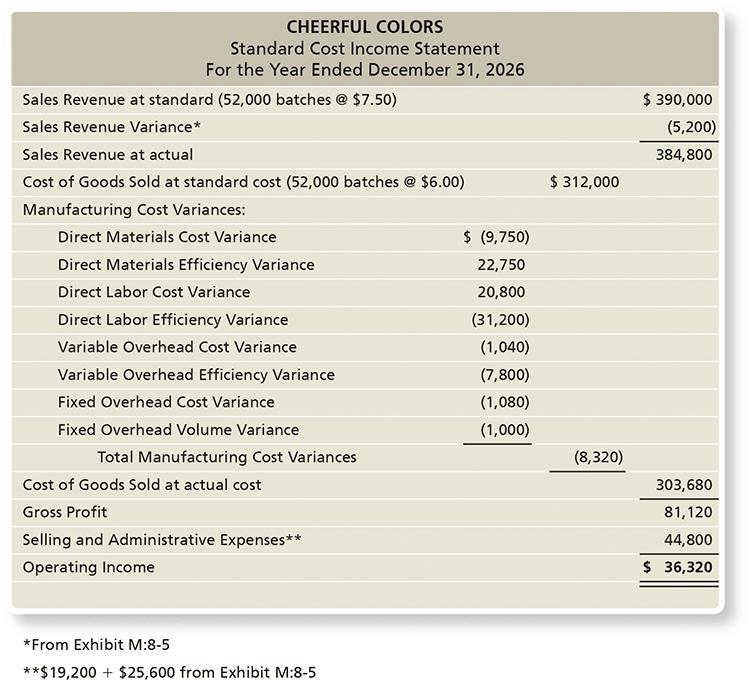
Standard Costing Income Statement
26
Journal entries of the Standard Cost System to record transactions.
(Next 8 Slides)
(Next 8 Slides)
Journal entries of the Standard Cost System to record transactions.
(Next 8 Slides)
(Next 8 Slides)
27
Transaction 1—Direct Materials Purchased
Explanation:
Raw Materials Inventory: Is the Standard (expected) cost for Raw Materials.
Direct Materials Cost Variance: Is the difference between the Standard Costs and the Actual Cost.
-Favorable is credited (like revenue) and unfavorable is debited (like an expense).
Accounts Payable: The actual cost for Raw Materials.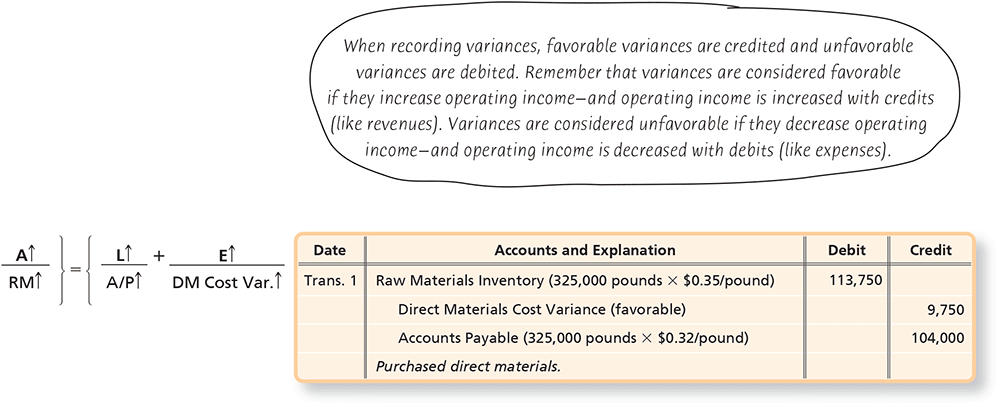
Raw Materials Inventory: Is the Standard (expected) cost for Raw Materials.
Direct Materials Cost Variance: Is the difference between the Standard Costs and the Actual Cost.
-Favorable is credited (like revenue) and unfavorable is debited (like an expense).
Accounts Payable: The actual cost for Raw Materials.
28
Transaction 2—Direct Materials Used
Explanation:
WIP Inventory: The standard (expected) amount of raw materials that should have been used.
Direct Materials Efficiency Variance: The difference between the actual amount of raw materials used vs the amount expected to be used.
-Favorable is credited (like revenue) and unfavorable is debited (like an expense).
-If the actual quantity used is more than the expected quantity to be used, that is BAD (unfavorable) since it is inefficient. (ex, some of the material might have gone bad)
Raw Materials Inventory: The actual amount of raw materials that were actually used.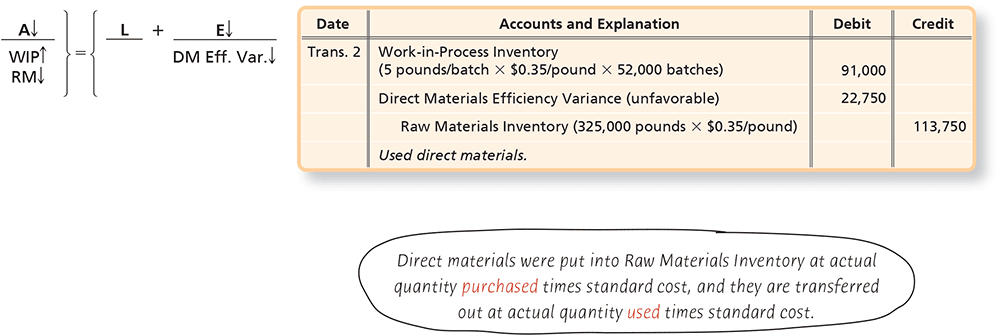
WIP Inventory: The standard (expected) amount of raw materials that should have been used.
Direct Materials Efficiency Variance: The difference between the actual amount of raw materials used vs the amount expected to be used.
-Favorable is credited (like revenue) and unfavorable is debited (like an expense).
-If the actual quantity used is more than the expected quantity to be used, that is BAD (unfavorable) since it is inefficient. (ex, some of the material might have gone bad)
Raw Materials Inventory: The actual amount of raw materials that were actually used.
29
Transaction 3—Direct Labor Incurred
Explanation:
WIP Inventory: The standard (expected) amount of direct labor that should have been used.
Wages payable: The actual amount of direct labor that was actually used.
Direct Labor Cost Variance and Direct Labor Efficiency Variance are both used when calculating direct labor hours transactions to find the difference between the expected vs the actual amount.
-Favorable is credited (like revenue) and unfavorable is debited (like an expense).
-If the amount per direct labor hour increases, or the amount of direct labor hours incurred (inefficient) are both unfavorable.
Use the formulas (you learned earlier in his flashcard) to find out both Variances.
Direct Labor Cost Variance:
(Actual Cost per hour - Standard Cost per hour) x Actual quantity of total direct labor hour
Direct Labor Efficiency Variance:
(Actual quantity of total direct labor hours -Standard quantity of total direct labor hours) x Standard cost per direct labor hour
*After you plug and chug the two formulas above, To figure whether they are favorable or unfavorable, just do
Direct Labor Cost Variance:
If, Actual cost per hour > Standard Cost per hour, then its unfavorable.
Direct Labor Efficiency Variance:
If, the Actual total direct labor hours > Standard total direct labor hours, then its unfavorable.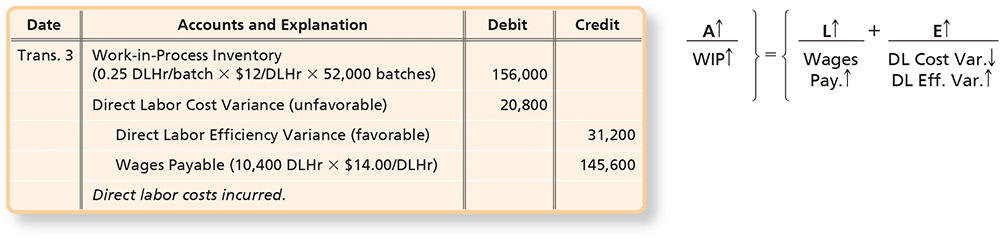
WIP Inventory: The standard (expected) amount of direct labor that should have been used.
Wages payable: The actual amount of direct labor that was actually used.
Direct Labor Cost Variance and Direct Labor Efficiency Variance are both used when calculating direct labor hours transactions to find the difference between the expected vs the actual amount.
-Favorable is credited (like revenue) and unfavorable is debited (like an expense).
-If the amount per direct labor hour increases, or the amount of direct labor hours incurred (inefficient) are both unfavorable.
Use the formulas (you learned earlier in his flashcard) to find out both Variances.
Direct Labor Cost Variance:
(Actual Cost per hour - Standard Cost per hour) x Actual quantity of total direct labor hour
Direct Labor Efficiency Variance:
(Actual quantity of total direct labor hours -Standard quantity of total direct labor hours) x Standard cost per direct labor hour
*After you plug and chug the two formulas above, To figure whether they are favorable or unfavorable, just do
Direct Labor Cost Variance:
If, Actual cost per hour > Standard Cost per hour, then its unfavorable.
Direct Labor Efficiency Variance:
If, the Actual total direct labor hours > Standard total direct labor hours, then its unfavorable.
30
Transaction 4—Manufacturing Overhead Incurred
Simple
Just debit Manufacturing Overheads an expense, and credit something like Cash for paying for plant repairs.
*PS: This represents the Actual Manufacturing Overhead for the entire period *
Just debit Manufacturing Overheads an expense, and credit something like Cash for paying for plant repairs.
*PS: This represents the Actual Manufacturing Overhead for the entire period *
31
Transaction 5—Manufacturing Overhead Allocated
Allocating Manufacturing Overhead to product costs.
Even though we have the actual manufacturing overhead from transaction 4, we will be using the standard overhead costs in this journal entry. This will later be adjusted with actual manufacturing overhead in the last journal entry.
You just do the
Standard (expected) overhead rate per allocation base x the actual amount of that allocation base
ex) If the allocation base is direct labour hours, then its
Standard (expected) overhead rate per direct labor hour x the actual amount of direct labour hours.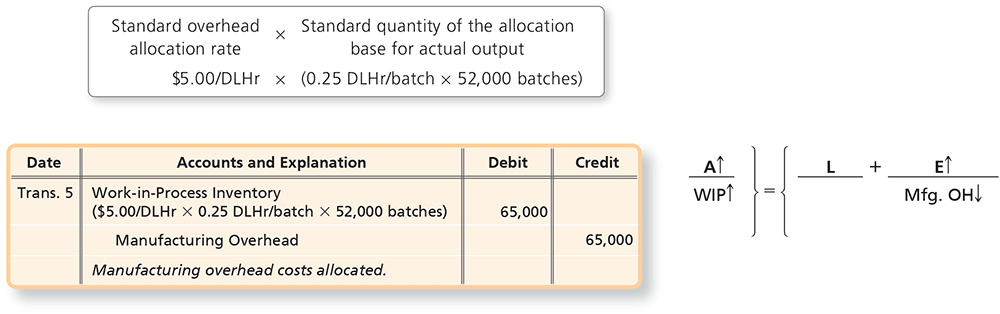
Even though we have the actual manufacturing overhead from transaction 4, we will be using the standard overhead costs in this journal entry. This will later be adjusted with actual manufacturing overhead in the last journal entry.
You just do the
Standard (expected) overhead rate per allocation base x the actual amount of that allocation base
ex) If the allocation base is direct labour hours, then its
Standard (expected) overhead rate per direct labor hour x the actual amount of direct labour hours.
32
Transaction 6—Goods Completed
Simple
Just move the WIP Inventory calculated before, into Finished Goods Inventory
!!!PS: The WIP Inventory is 100% based on Standard costs!!!!!
Just move the WIP Inventory calculated before, into Finished Goods Inventory
!!!PS: The WIP Inventory is 100% based on Standard costs!!!!!
33
Transaction 7—Goods Sold
Simple
When the goods are sold, just move finished goods inventory into Cost of Goods Sold
When the goods are sold, just move finished goods inventory into Cost of Goods Sold
34
Transaction 8—Manufacturing Overhead Adjusted
Explanation:
If Manufacturing Overhead is Overallocated (actual is less than allocated (expected)), then Manufacturing Overhead is debited. and If Manufacturing Overhead is Underallocated (actual is more than allocated (expected)), then Manufacturing overhead is credit.
This is similar to a Traditional Costing System
Overallocated: Need to expense less in the cost of goods sold
Dr MOH
Cr COGS
Underallocated: Need to expense more in the cost of goods sold.
Dr COGS
Cr MOH
Except, you replace COGS with all 4 Variances.
-Favorable variances are credited (like revenue) and unfavorable variances are debited (like an expense).
So, the more unfavorable, the more Manufacturing Overhead is Underallocated. (& Vis versa)
*Also, some of the variances can be favorable, while other are unfavorable. Whichever one has the most wins.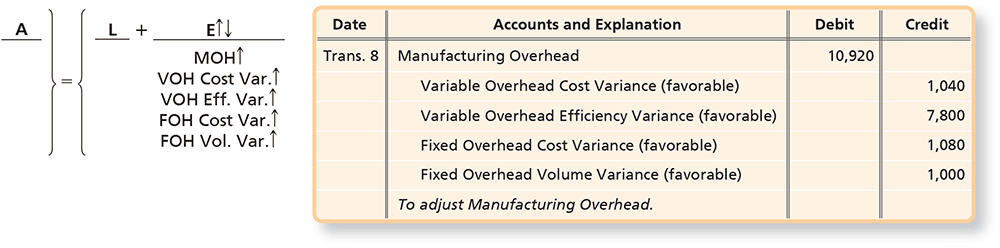
If Manufacturing Overhead is Overallocated (actual is less than allocated (expected)), then Manufacturing Overhead is debited. and If Manufacturing Overhead is Underallocated (actual is more than allocated (expected)), then Manufacturing overhead is credit.
This is similar to a Traditional Costing System
Overallocated: Need to expense less in the cost of goods sold
Dr MOH
Cr COGS
Underallocated: Need to expense more in the cost of goods sold.
Dr COGS
Cr MOH
Except, you replace COGS with all 4 Variances.
-Favorable variances are credited (like revenue) and unfavorable variances are debited (like an expense).
So, the more unfavorable, the more Manufacturing Overhead is Underallocated. (& Vis versa)
*Also, some of the variances can be favorable, while other are unfavorable. Whichever one has the most wins.
35
A. Production Manager
This is because the direct Labor Efficiency Variance is
(Actual Hours - Standard Hours) x Standard (expected) hourly rate per direct hour
*This is measuring the difference between the Actual hours and the standard (expected) amount of hours.
-The production manager has control over how many direct labor hours are used in production
-Human resources has control over who to hire and how much to hire them for per hour.
The person probably most responsible for the direct labor efficiency variance is
A.
the production manager.
B.
the purchasing manager.
C.
the human resources manager.
D.
the marketing manager.
A.
the production manager.
B.
the purchasing manager.
C.
the human resources manager.
D.
the marketing manager.
A. Production Manager
This is because the direct Labor Efficiency Variance is
(Actual Hours - Standard Hours) x Standard (expected) hourly rate per direct hour
*This is measuring the difference between the Actual hours and the standard (expected) amount of hours.
-The production manager has control over how many direct labor hours are used in production
-Human resources has control over who to hire and how much to hire them for per hour.
Mehr Karteikarten: Wirtschaft
Chapter 9 Vocab - Supply ChainWirtschaft · Englischbevo612Chapter 1 Vocab - Supply ChainWirtschaft · Englischbevo612CS 422 Q1 YBWirtschaft · EnglischJajitaIAS 1 Presentation of Financial StatementsWirtschaft · EnglischEllaapproaches to developing business strategy Wirtschaft · EnglischDariusRisk Management: Exposure, Likelihood and ControlsWirtschaft · EnglischColeMRKT 350 Marketing Analytics Exam ReviewWirtschaft · EnglischMarinAuditing and Fraud Detection Exam ReviewWirtschaft · EnglischwowiepowDerivative Securities MarketsWirtschaft · EnglischMercedesHow markets workWirtschaft · Englischeinem OutLearn-StudierendenSociology, Labour Process and ManagementWirtschaft · EnglischrikishakennedyKey TermsWirtschaft · EnglischJonathan
Lerne diese Decks in der App
Kostenlos auf iPhone, Android, Mac und im Web. Füge jedes Deck mit einem Tipp zu deinem Konto hinzu.

