ACG2071 Chapter 11 (Principles of Managerial Accounting)
Diese Karteikarten lernenKostenlos · Spaced Repetition · iPhone, Android, Mac & Web
Alle Karten
1
Capital Assets
The operational assets businesses use for long periods of time.
2
Capital Investment
When a company purchases a capital asset.
3
Capital Budgeting
The process of investing into capital assets
4
Capital Rationing
Capital rationing is the process of ranking and choosing among alternative capital investments based on the availability of funds.
So, maybe for a project you wait to the net 3 years to do it to get more funds, and there are mor eimportant projects to invest in.
So, maybe for a project you wait to the net 3 years to do it to get more funds, and there are mor eimportant projects to invest in.
5
Post audit
The comparison of the actual results of the capital investment vs the projected results.
6
Net Cash Inflow
Generate more cash inflow than Cash outflow, over the useful life of an asset
"The desirability of a capital asset depends on its ability to generate net cash inflows—that is, cash inflows in excess of cash outflows—over the asset’s useful life."
"The desirability of a capital asset depends on its ability to generate net cash inflows—that is, cash inflows in excess of cash outflows—over the asset’s useful life."
7
Payback
(Including the formula)
(Including the formula)
Payback is a capital investment analysis method that measures the length of time it takes to recover, in net cash inflows, the cost of the initial investment.
8
1. Main criticism of the payback method.
2. Also, why would they use the payback method, even due to the main criticism?
2. Also, why would they use the payback method, even due to the main criticism?
1. It only focuses on the time it ill take to pay it back. Ot completely ignores profits afterward.
If after you break even, what if it just generates \$0 or \$1 million. This would not take that into consideration.
2.
"The key point is that the investment with the shortest payback is best only if all other factors are the same.
Therefore, managers usually use the payback method as a screening device to eliminate investments that will take too long to recoup the initial investment.
They rarely use payback as the sole method for deciding whether to invest in the asset."
9
Accounting Rate of Return (ARR)
(Include the Formula)
*Continued for next 2 slides
(Include the Formula)
*Continued for next 2 slides
"The accounting rate of return (ARR) is a capital investment analysis method that measures the profitability of an investment."
ARR measures the average annual rate of return over the asset’s entire life
ARR measures the average annual rate of return over the asset’s entire life
10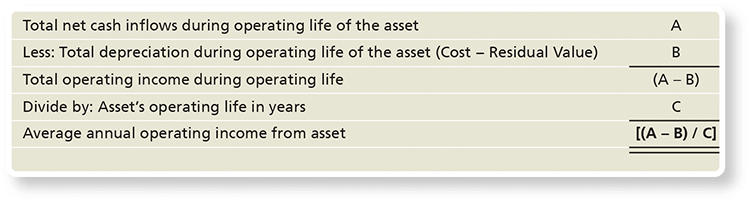
Average Annual operatig Income Formula
11
Average Amount Invested Formula
PS: Residual value is the estimate value of an asset at the end of its useful life.
12
time value of money
Recognition that money earns interest over time.
13
Lump-Sum vs Annunity
Lump Sum: Receive all the money at once (ex, you get get a singular lump-sum of \$1,200)n
Annuity: A stream of equal cash payment made at equal time intervals (ex, \$100 every month for 12 months)
Annuity: A stream of equal cash payment made at equal time intervals (ex, \$100 every month for 12 months)
14
The time value of money depends on 3 key factors: (Image)
*What do these three mean exactly?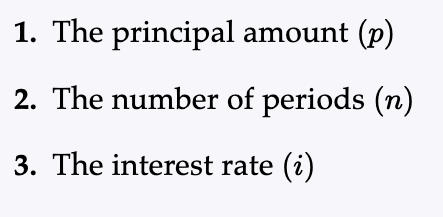
*What do these three mean exactly?
1. The amount of the investment (stated in a lump-sum or an Annunity)
2. The number of periods is from the beginning to the end of the investment
3. The interest rate (i) is the annual percentage earned on investment
2. The number of periods is from the beginning to the end of the investment
3. The interest rate (i) is the annual percentage earned on investment
15
Simple Interest:
Compound Interest:
Compound Interest:
Simple Interest: Interest is only calculated on the principal amount
Compound Interest: Interest is calculated on the principal and on all previously earned interest
Compound Interest: Interest is calculated on the principal and on all previously earned interest
16
If we invest \$10,000 today, (invested for 5 years at 6% annual interest)
1. What is the Present Value
2. What is the Future Value
1. What is the Present Value
2. What is the Future Value
1. The Present Value is \$10,000
2. The Future Value is (10,000)+((10,000 x 0.06)5) = \$13,838
2. The Future Value is (10,000)+((10,000 x 0.06)5) = \$13,838
17
If we know the future value of an investment, how would we find the present value?
(ex, the future value is \$13,838, and you earned \$3,838 in interest)
(ex, the future value is \$13,838, and you earned \$3,838 in interest)
(ex, the present value would be \$10,000)
18
Present Value Lump Sum
ex) “How much would I have to invest today (in the present time) to have \$13,383 five years in the future if I invested at 6%?”
ex) “How much would I have to invest today (in the present time) to have \$13,383 five years in the future if I invested at 6%?”
Step 1: Go to the Present Value Lump-sum table, and got to where the period is 5 and the percentage is 6. (Image)
Step 2: Its 0.747, so follow the formula
Present Value = Future Value x PV factor for i = 6%, n = 5
Present Value = \$13,383 x 0.747
Present Value = \$9,997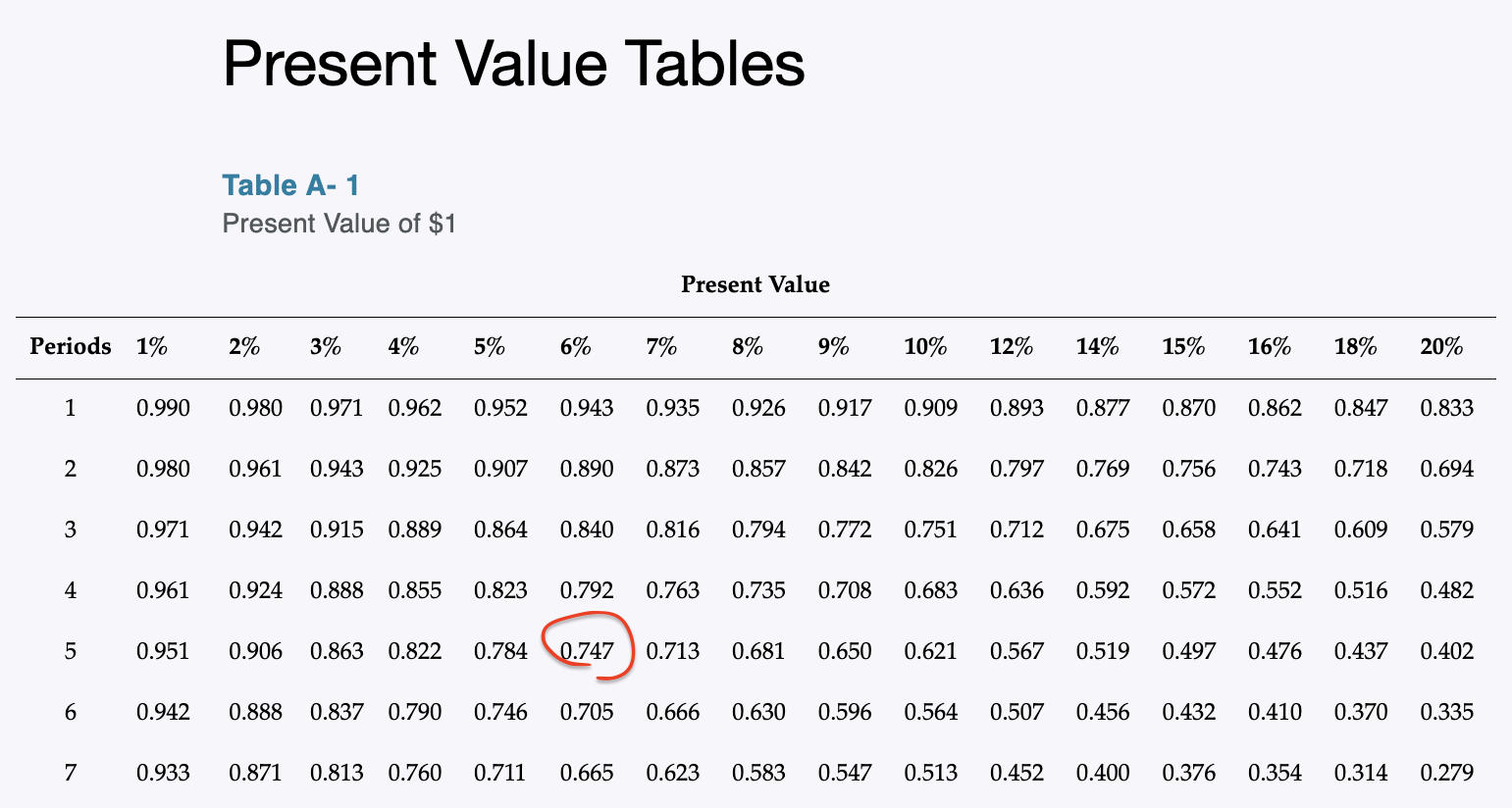
Step 2: Its 0.747, so follow the formula
Present Value = Future Value x PV factor for i = 6%, n = 5
Present Value = \$13,383 x 0.747
Present Value = \$9,997
19
Present Value Annuity
ex)How much would I have to invest today (in the present time) to get 2,000 each year, for 5 years
ex)How much would I have to invest today (in the present time) to get 2,000 each year, for 5 years
Step 1: Go to the Present Value Annuity table and find where it is period is 5 and percnetage of 6. (Image)
Step 2: It's 4.212, so follow the formula
Present Value = Future Value x PV factor for i = 6%, n = 5
Present Value = 2,000 x 4.212
Present Value = \$8,424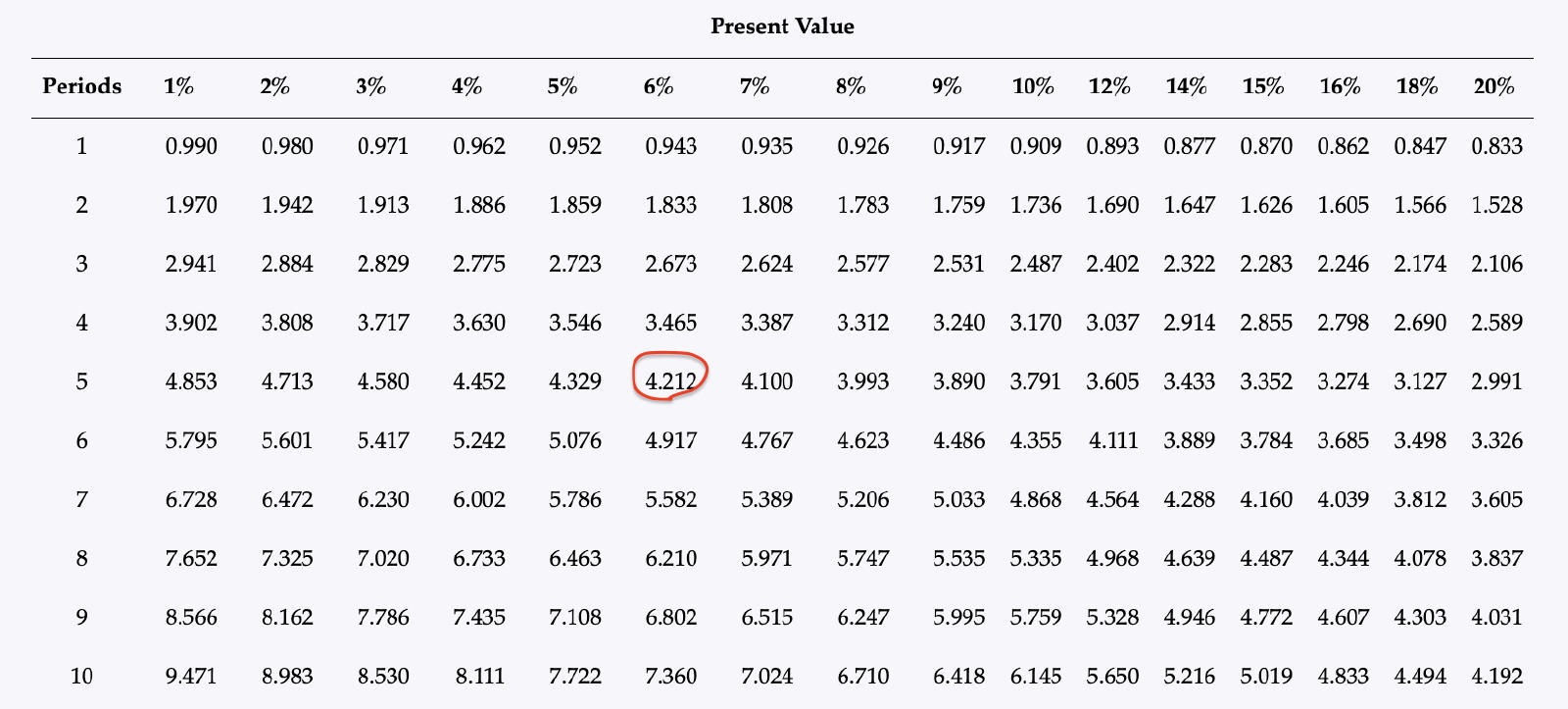
Step 2: It's 4.212, so follow the formula
Present Value = Future Value x PV factor for i = 6%, n = 5
Present Value = 2,000 x 4.212
Present Value = \$8,424
20
Future Value of Lump-Sum
ex) If I invested \$10,000 today, for 5 years at 6% interest, how much would I get?
ex) If I invested \$10,000 today, for 5 years at 6% interest, how much would I get?
Step 1: Go to the Future Value Lump-Sum table, and find where the period is 5 and the percentage is 6. (Image)
Step 2: Its 1.338, so then follow the formula
Future Value = Present Value x FV factor for i = 6%, n = 5
Future Value = 10,000 x 1.338
Future Value = \$13,38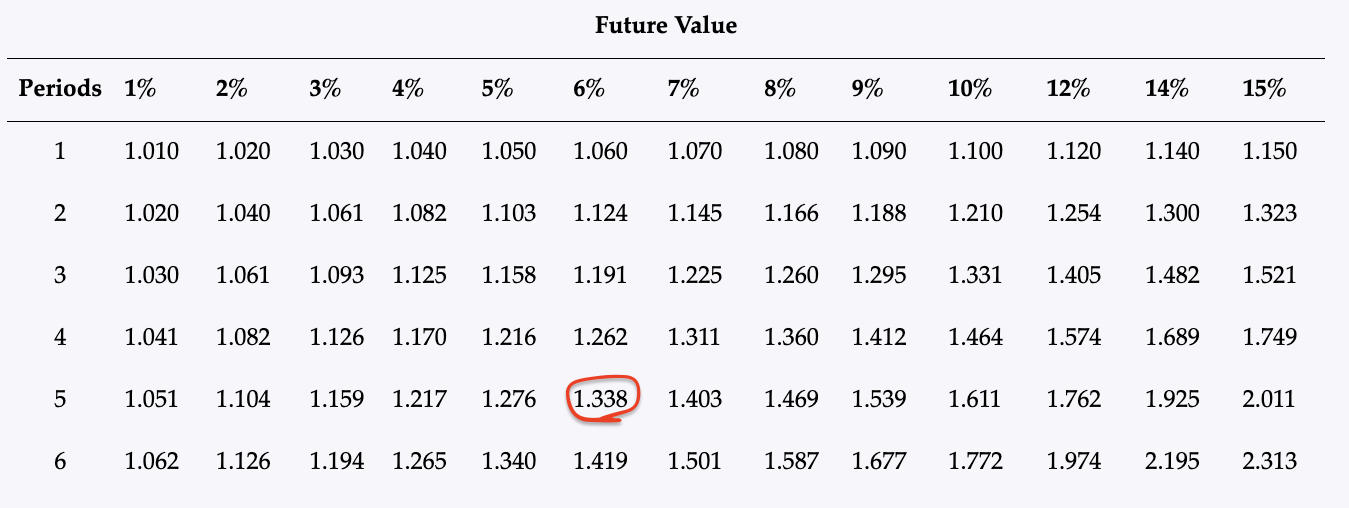
Step 2: Its 1.338, so then follow the formula
Future Value = Present Value x FV factor for i = 6%, n = 5
Future Value = 10,000 x 1.338
Future Value = \$13,38
21
Future Value Annuity
ex) If I invest \$2,000 each year for 5 years at 6% interest, how much would I get at the end?
ex) If I invest \$2,000 each year for 5 years at 6% interest, how much would I get at the end?
Step 1: Go to the Future Value Annunity table, and find where the period is 5 and the percentage is 6. (Image)
Step 2: Its 5.637, so then follow the formula
Future Value = Present Value x FV factor for i = 6%, n = 5
Future Value = \$2,000 x 5.637
Future Value = \$11,274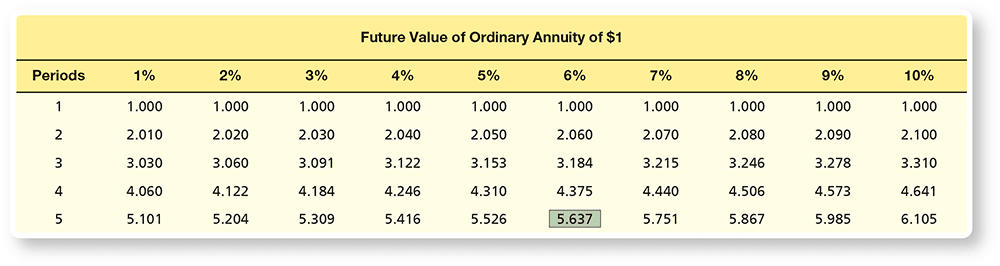
Step 2: Its 5.637, so then follow the formula
Future Value = Present Value x FV factor for i = 6%, n = 5
Future Value = \$2,000 x 5.637
Future Value = \$11,274
22
Net Present Value?
Net Present Value: The difference between the present value of the investments net cash inflows and the investments initial cost.
The present value is based on i (interest) and n (periods), specifically with interest based on the target interest
The present value is based on i (interest) and n (periods), specifically with interest based on the target interest
23
Discount Rate
Managements minimum desired rate of return on a capital investment.
24
How to find the NPV of these two projects? (Both have an initial investment of \$1,000,000)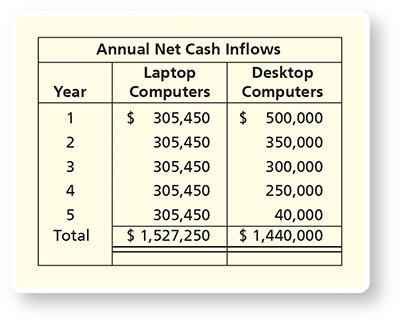
Step 1: The NPV is the difference between the present value and the initial investment. So, to the find the Present Value,
-Laptop Computers: Just do the steps for "Present Value Annuity" found in a previous slide. (SInce cash flow is equal each year)
-Desktop Computers: Since the cash flow is not equal each your, you have to calculate a lump-sum method for each year. (Shown in image)
Step 2: After you have the present value, just subtract it from the initial investment, which is \$1,000,000.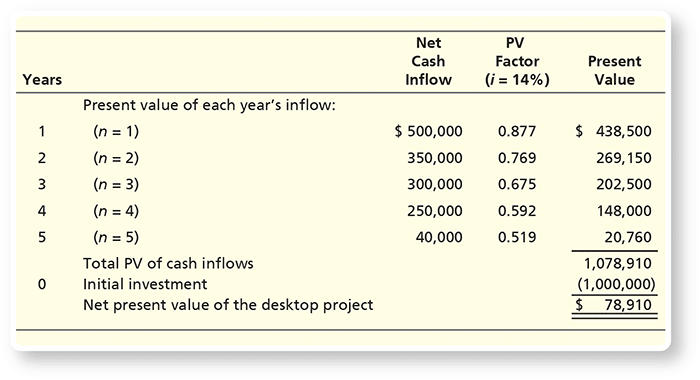
-Laptop Computers: Just do the steps for "Present Value Annuity" found in a previous slide. (SInce cash flow is equal each year)
-Desktop Computers: Since the cash flow is not equal each your, you have to calculate a lump-sum method for each year. (Shown in image)
Step 2: After you have the present value, just subtract it from the initial investment, which is \$1,000,000.
25
How to find the NPV of this project?
Residual Value: \$100,000
Initial Investment: \$1,000,000
i = 14%, n = 5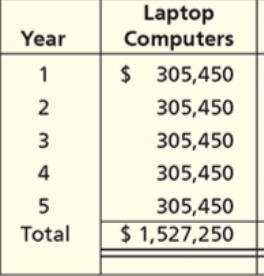
Residual Value: \$100,000
Initial Investment: \$1,000,000
i = 14%, n = 5
The residual value is treated as a lump-sum, so you need to use the Lump-sum PV factor.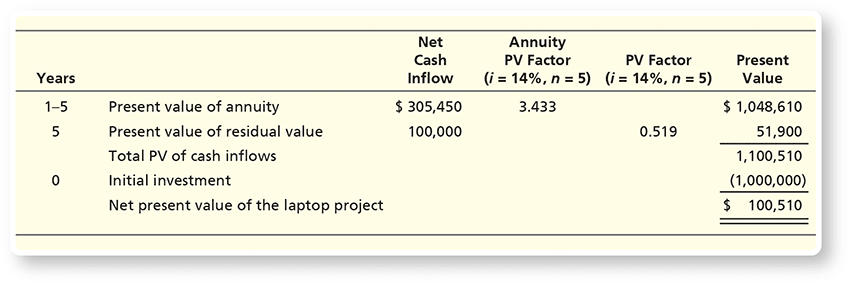
26
Profitiability Index
-The profitability index computes the number of dollars returned for every dollar invested, with all calculations performed in present value dollars.
Formula: (Shown at the top of the image)
*Project C is the best since it returns \$1.21 (in present value dollars) for every \$1.00 invested.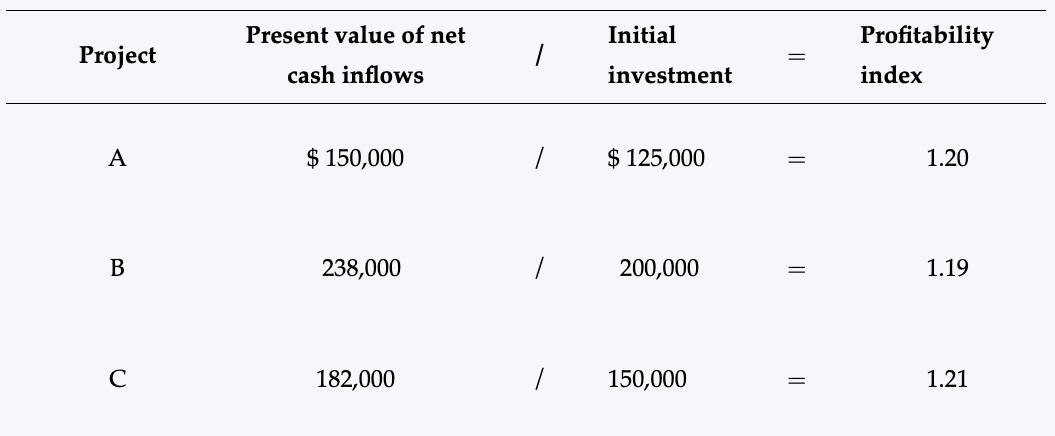
Formula: (Shown at the top of the image)
*Project C is the best since it returns \$1.21 (in present value dollars) for every \$1.00 invested.
Mehr Karteikarten: Wirtschaft
CH1 - The Field of Engineering ManagementWirtschaft · EnglischPascual,Chapter 9 Econ BehavWirtschaft · EnglischshyannekendraAccounting Analytical Measures Wirtschaft · EnglischJosiahEcon 101 - Lecture 2Wirtschaft · EnglischVincent2 A Brand Its Image and Its WorthWirtschaft · EnglischJohnMarketing Basics: Exchange, Markets and MixWirtschaft · EnglischCallieLeadership Styles: Autocratic, Participative and MoreWirtschaft · EnglischnightmareTürsteuerung, Aufgaben ZGF, StreckenlisteWirtschaft · DeutschJuliaFundamentals of Management: HRMWirtschaft · EnglischLexieMacro Exam 1 Wirtschaft · EnglischEmmaModule 1 PracticeWirtschaft · EnglischOliver_SLESSON 4: DATA MANAGEMENT AND ANALYSISWirtschaft · EnglischDion
Lerne diese Decks in der App
Kostenlos auf iPhone, Android, Mac und im Web. Füge jedes Deck mit einem Tipp zu deinem Konto hinzu.

