ACG 3103 Chapter 6 (Intermediate Financial Accounting)
Diese Karteikarten lernenKostenlos · Spaced Repetition · iPhone, Android, Mac & Web
Alle Karten
1
short term highly liquid investments called?
Cash Equivalents
2
What are
1. Post dated Checks
2. IOU's
*And, are they classfied as receivables or cash?
1. Post dated Checks
2. IOU's
*And, are they classfied as receivables or cash?
1. Post-Dated Checks: Are checks which cannot be depsoited in a future date.
2. IOU's: Represent an amount that is owed to the company
*Both are classfied as receivables.
2. IOU's: Represent an amount that is owed to the company
*Both are classfied as receivables.
3
Restricted Cash
Restricted Cash: Cash that is restricted for a certain purpose. If it is restricted for a current obligation, then it is considered a current asset, however, if it is restricted for a long-term obligation, then it is considered a long-term asset.
4
Compensating Balance
(Also, how should they be reported?)
(Also, how should they be reported?)
A Compensating Balance is the minimum amount a lender requires a borrower to keep in their account as a condition for receiving a loan.
-Compensating Balances against short-term borrowing should be classfied as a current asset and a part of "Cash and Cash Equivalents"
-Compensating Balances against long-term borrowing should be classied as a noncurrennt asset under investments or other assets section, and naming it "Cash on deposit maintained as compensating balance"
5
Bank Overdraft
(Also, what is this classfied as, Asset, Liability or Equity and whether or not it is current or non current)
(Also, what is this classfied as, Asset, Liability or Equity and whether or not it is current or non current)
Ban Overdraft: When you spend more money then what is in your account, so the bank covers the transaction and you have to pay it off later
*Classfied as a Current liabiility
*Classfied as a Current liabiility
6
Short Term Paper
1. What is it
2. How is it classified?
1. What is it
2. How is it classified?
1. A Short Term Paper is a short term (under a year) debt agreement (basically a loan)
2.
-When the investment matures in less than 3 months : It is considered a Cash Equivalent
-When the investment matures 3 months - 12 months: It is considered a Short-Term Investment
2.
-When the investment matures in less than 3 months : It is considered a Cash Equivalent
-When the investment matures 3 months - 12 months: It is considered a Short-Term Investment
7
1. What is a travel advance?
2. What is it classfied as?
2. What is it classfied as?
1. Travel Advance: A travel advance is a pre-approved sum of money given by an employer or organization to an employee before a business trip
2. Classfied as a receivable
2. Classfied as a receivable
8
1. What is a Postage on Hand?
2. What is it classfied as?
2. What is it classfied as?
1. Postage on Hand: It is postages that the company has not used yet.
2. It is classfied as a Prepaid Expense.
2. It is classfied as a Prepaid Expense.
9
1. Trade Receivable
2. Non-Trade Receivable
2. Non-Trade Receivable
1. Trade Receivable: Amounts owed to a company by customers for good(s) or service(s) sold
2. Non-Trade Receivable: Amounts owed to a company from sources outside of its primary, everyday business operations
2. Non-Trade Receivable: Amounts owed to a company from sources outside of its primary, everyday business operations
10
Differences between Accoutns Receivables vs Notes Receivables
1.
Accounts Receivables: Informal agreement based on an invoice
Notes Receivables: Binding by a contract signed by both parties
2.
Accounts Receivables: Typically has no interest
Notes Receivables: Typically has interest
3.
Accounts Receivables: Always Short-term
Notes Receivables: Can be short-term (less than one year) or long-term
11
Fixed vs Variable Consideration
Fixed Consideration: Unchaning payment amount
Variable Consideration: Payment amount can flucate based on future events ( (1) trade discounts, (2) cash discounts, (3) sales returns and allowances, and (4) time value of money. )
Variable Consideration: Payment amount can flucate based on future events ( (1) trade discounts, (2) cash discounts, (3) sales returns and allowances, and (4) time value of money. )
12
Trade Discount
"A trade discount is a reduction from a product's regular catalog or list price, offered by a manufacturer or wholesaler to a buyer "
13
Cash Discounts (Sales Discounts)
A sales discount is a reduction in the price of a product or service that a seller offers to a customer as an incentive to pay an invoice early
14
Explain each of these
1) 2/10, n/30
2) 2/10, E.O.M., net 30, E.O.M.
1) 2/10, n/30
2) 2/10, E.O.M., net 30, E.O.M.
1) 2/10, n/30:
Get a 2% discount if you pay within 10 days, but must pay the full amount in 30 days
2) 2/10, E.O.M., net 30, E.O.M. :
Get a 2% discount if paid any time by the 10th day of the following month, with full payment due by the 30th of the following month)
Get a 2% discount if you pay within 10 days, but must pay the full amount in 30 days
2) 2/10, E.O.M., net 30, E.O.M. :
Get a 2% discount if paid any time by the 10th day of the following month, with full payment due by the 30th of the following month)
15
Gross Method vs Net Method for Cash (Sales Discounts)
ALSO, give the sellers and buyers Journal entries for both gross and net method. (Ex, 1,000 sold with a \$200 discount if they pay early)
ALSO, give the sellers and buyers Journal entries for both gross and net method. (Ex, 1,000 sold with a \$200 discount if they pay early)
Gross Method: Records accounts receivable and sales revenue at the full gross price (Assuming that the customer will nottake the cash discount)
Net Method: Records accounts receivable and sales revenue at the price after discount (Asumming that the customer will take the cash discount)
Net Method: Records accounts receivable and sales revenue at the price after discount (Asumming that the customer will take the cash discount)
16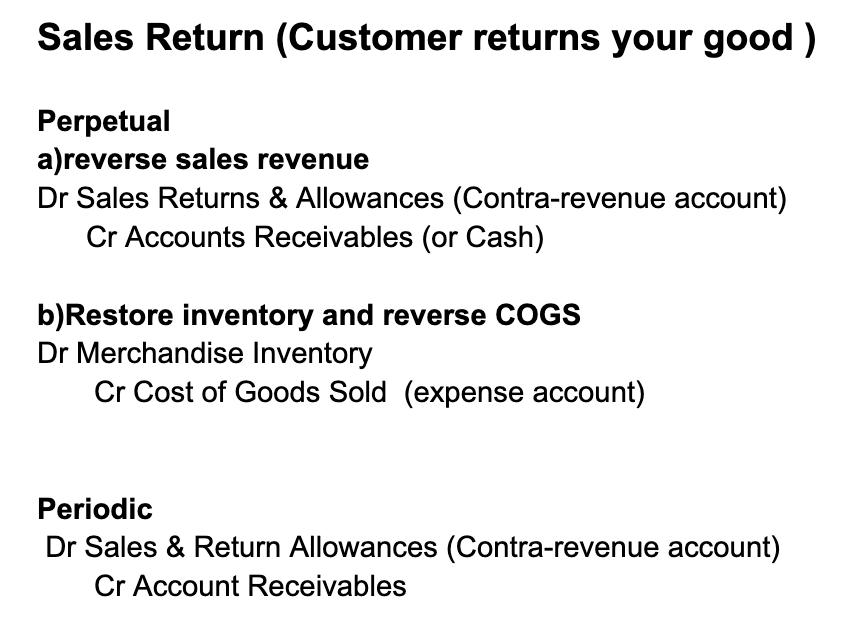
Sales Return J.E.
17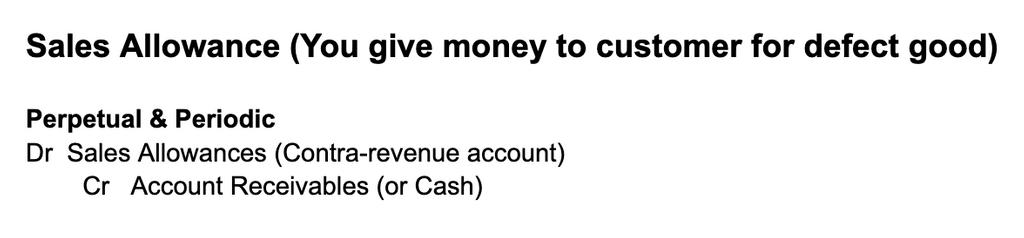
Sales Allowance J.E.
18
Direct Write-Off Method for Uncollectible Accounts
vs
Allowance Method for Uncollectible Accounts
*Also, which is allowed by GAAP?
vs
Allowance Method for Uncollectible Accounts
*Also, which is allowed by GAAP?
Direct Write-Off Method for Uncollectible Accounts (Non-GAAP):
-As soon as you determine an accounts receivable is uncollectible, you put the loss towards 'Bad Debt Expense'
Allowance Method for Uncollectible Accounts (GAAP):
-In the adusting entry at the end of the period, you estimate the amount of accounts receivables which will go uncollectible. Then, when you know the exact accounts receivable which will become uncollectible, then you reduce the "Allowance to Bad Debts" (Contra-Asset Account) and just reduce accounts receivables.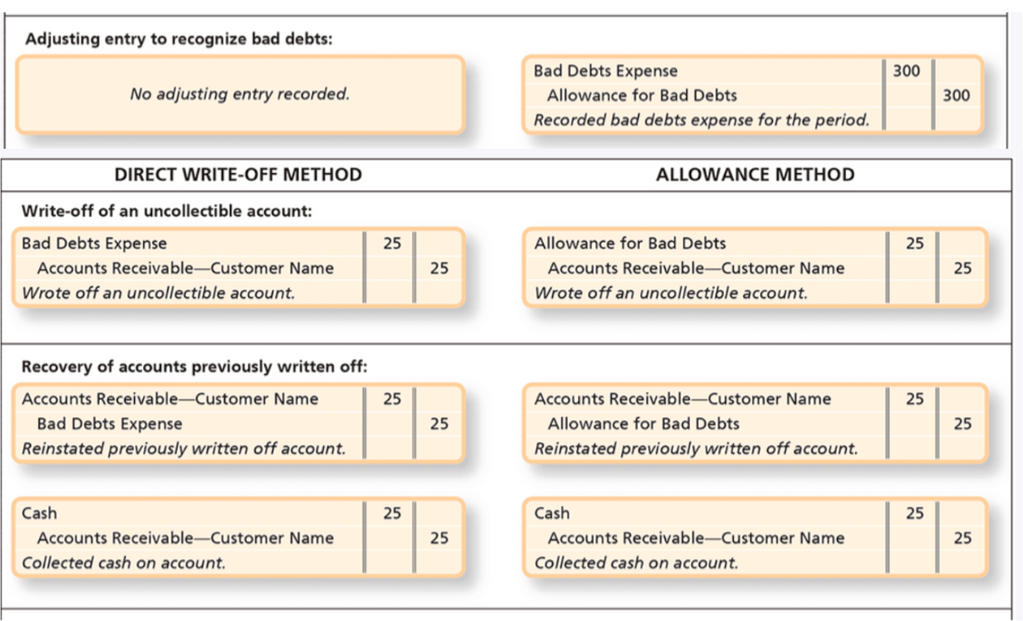
-As soon as you determine an accounts receivable is uncollectible, you put the loss towards 'Bad Debt Expense'
Allowance Method for Uncollectible Accounts (GAAP):
-In the adusting entry at the end of the period, you estimate the amount of accounts receivables which will go uncollectible. Then, when you know the exact accounts receivable which will become uncollectible, then you reduce the "Allowance to Bad Debts" (Contra-Asset Account) and just reduce accounts receivables.
19
Cash Realized value / Net Realized Value for Accounts Receivable meaning?
The amount of cash a company genuinely expects to collect from its customers
20
1) Composite Rate Approach
-You have a Composite Rate (Which you can develop in any way), which is the % of all receivables which will be uncollectable.
-Relatively lower precision compared to Aging Schedule Approach
2) Aging Schedule Approach
*Shown in Image
-Gives different % of accounts receivables which would be uncollectible based on how many days have passed since the invoice was issued (or became past due).
-So, the longer the amount of days have, the higher the estimated % will be uncollectible.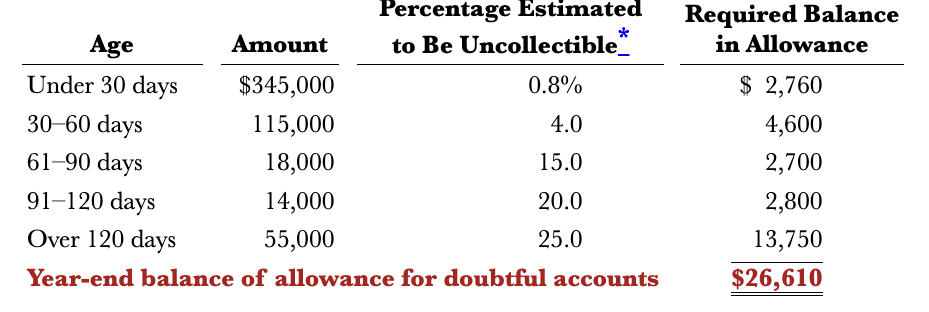
Percentage-of-receivables (What is it, and what are the two methods)
1) Composite Rate Approach
-You have a Composite Rate (Which you can develop in any way), which is the % of all receivables which will be uncollectable.
-Relatively lower precision compared to Aging Schedule Approach
2) Aging Schedule Approach
*Shown in Image
-Gives different % of accounts receivables which would be uncollectible based on how many days have passed since the invoice was issued (or became past due).
-So, the longer the amount of days have, the higher the estimated % will be uncollectible.
21
What should you do in the Allowance Method if,
You are making the end of period adjustment to estimate the amount uncollectible
1) The 'Allowance for Doubtful Accounts' has a credit balance of \$800 (Also, what does having a credit balance mean?)
2) The 'Allowance for Doubtful Accounts' has a debit balance of \$800 (Also, what does having a debit balance mean?)
1) The 'Allowance for Doubtful Accounts' has a credit balance of \$800
-This means that the company overestimated and did not write off as many accounts receivables as uncollectible as expected. They overestimated by \$800.
-In this case, you minus \$800 from the adjusting entry (as in in subtract 800 from both 'Bad Debt Expense' & 'Allowance for Doubtful Accounts') you woud have made if you had a beginning balance of 0. So, if you calculated \$2,000 for your estimated Allowance for Doubtful Accounts, you now have to take into account the beginning balance and subtract the 2,000 by 800.
2) The 'Allowance for Doubtful Accounts' has a debit balance of \$800
-This means that the company underestimated the amount of accounts receivables that would be uncollectible. They underestimated by \$800.
-In this case, you add \$800 from the adjusting entry (as in in add 800 from both 'Bad Debt Expense' & 'Allowance for Doubtful Accounts') you woud have made if you had a beginning balance of 0. So, if you calculated \$2,000 for your estimated Allowance for Doubtful Accounts, you now have to take into account the beginning balance and add the 2,000 by 800.
22
What does the credit loss (CECL) model require from companies?
The current expected credit loss (CECL) model that requires companies to measure expected uncollectible accounts and record bad debt expense on all receivables
23
What is a
1) Interest-bearing notes
2) Zero-interest-bearing notes
1) Interest-bearing notes
2) Zero-interest-bearing notes
1) Interest-bearing notes: A note that has a stated interest rate
2) Zero-interest-bearing notes : A note that does not have a stated interest rate.
-PS: Zero Interest Notes will not have explicit interest rate; however, the borrower is issued at a discount to the face value. (Meaning they they for example get \$100 but will have to pay the face value of \$109 next year. This functions the same as interest, without having an explict interest rate.)
Mehr Karteikarten: Wirtschaft
ProfitabiltyWirtschaft · EnglischDigbyECON QUIZ 1Wirtschaft · EnglischSantiagoP2 Treatment of Uncertainty & Risk in decision makingWirtschaft · EnglischEllaAccounting PrinciplesWirtschaft · EnglischEriniEmployee Relations Exam 1Wirtschaft · EnglischLexieAuditing and Accounting Standards Exam 1Wirtschaft · EnglischwowiepowPrincipes de revenue management Wirtschaft · FranzösischalixURBS 250 FINAL*Wirtschaft · EnglischAlyssaMan Ind Exam 1Wirtschaft · EnglischLexieInvestment Analysis chaps 7, 8, 10Wirtschaft · Englischmattmc03Chapter Three: Money Management Strategy: Financial Statements and BudgetingWirtschaft · EnglischLexiFinance ExamWirtschaft · EnglischCharley
Lerne diese Decks in der App
Kostenlos auf iPhone, Android, Mac und im Web. Füge jedes Deck mit einem Tipp zu deinem Konto hinzu.

