ACG2021 Chapter 13 (Principles of Financial Accounting)
Diese Karteikarten lernenKostenlos · Spaced Repetition · iPhone, Android, Mac & Web
Alle Karten
1
Authorized Stock
The maximum amount of shares of stock that a corporate charter allows a corporation to issue.
2
Issued Stock
Stock that has been issued by the corporation but may or may not be held by stockholders
‘may or may not be held by stockholders’ means that the company could have bought it back.
‘may or may not be held by stockholders’ means that the company could have bought it back.
3
Stock Certificate
Paper evidence of ownership in a corporation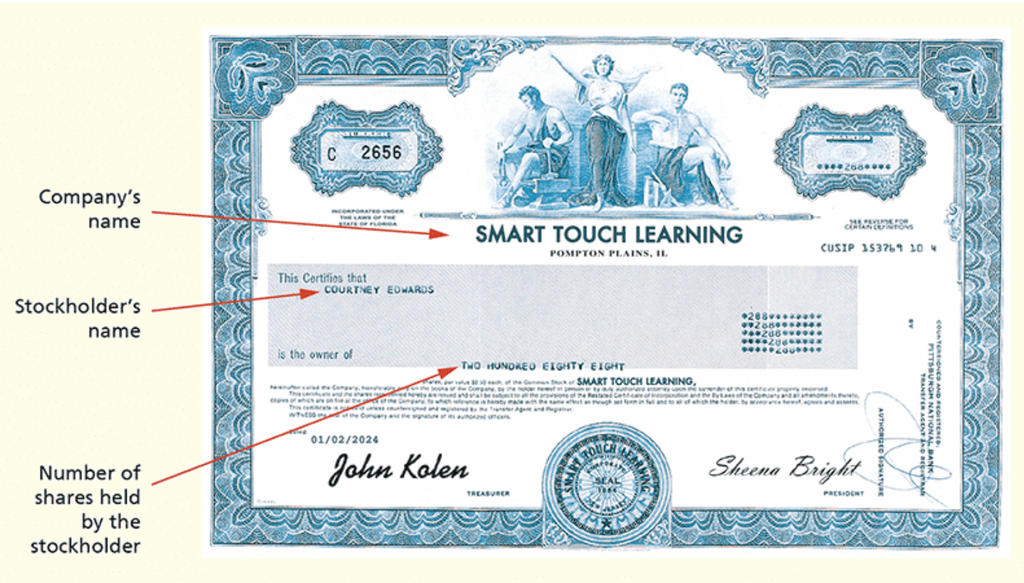
4
Capital Stock
Represents the individual’s ownership of the corporation’s capital
5
Outstanding
Issued stock in the hands of stockowners.
6
Stock Holders 4 basic rights (unless right is withheld by contract)
1. Vote: Stockholders participate in management indirectly by voting on corporate matters at stockholders’ meetings
2. Dividend (distribution of corporates earnings to stock holders)
3. Liquidation: Stockholders receive their proportionate share of any assets remaining after the corporation pays its debts and liquidates (goes out of business)
4. Preemptive Right: Stockholders right to maintain their proportionate ownership in a corporation (For example, suppose someone owns 5% of the company stock. If the company offers 100,000 of new stock, they must offer the stockholder the opportunity to buy 5,000 stock). However, this right is usually withheld by contracts for most corporations.
2. Dividend (distribution of corporates earnings to stock holders)
3. Liquidation: Stockholders receive their proportionate share of any assets remaining after the corporation pays its debts and liquidates (goes out of business)
4. Preemptive Right: Stockholders right to maintain their proportionate ownership in a corporation (For example, suppose someone owns 5% of the company stock. If the company offers 100,000 of new stock, they must offer the stockholder the opportunity to buy 5,000 stock). However, this right is usually withheld by contracts for most corporations.
7
Preferred Stock
Stock that gives its owners certain advantages over common stockholders, such as the right to receive dividends before the common stockholders and the right to receive assets before the common stockholders if the corporation
8
Par Value
Par value is generally the minimum legal price at which a corporation can originally issue (sell) shares of stock to investors.
*Par value for preferred stock is usually higher than common stock
*Par value for preferred stock is usually higher than common stock
9
Non-par stock
Stock that has no par value assigned to it.
10
Stated Value Stock
Stated Value Stock is no-par stock that has been assigned an amount similar to par value. Stated value represents the minimum amount that the corporation can issue the stock for.
*For accounting purposes the state value stock and the par value are treated the same, with the only differences being the account names
*For accounting purposes the state value stock and the par value are treated the same, with the only differences being the account names
11
What are the two main sources of Stockholder Equity
1. Paid-in Capital (contributed capital): represents the amount received from stock holders in exchange for stock
2. Retained Earnings: is equity earned by profitable operations that is not distributed to stockholders.
2. Retained Earnings: is equity earned by profitable operations that is not distributed to stockholders.
12
Underwriter
A firm that handles the issuance of a company's stock to the public, usually assuming some of the risk by agreeing to buy the stock if the firm cannot sell all of the stock to its clients.
13
Issue Price
The amount the corporation receives for issuing stock
14
Journal Entry to issue 15,000 shares of stock at the par value of \$1.
15
Premeium
The amount above par at which stock is issued.
16
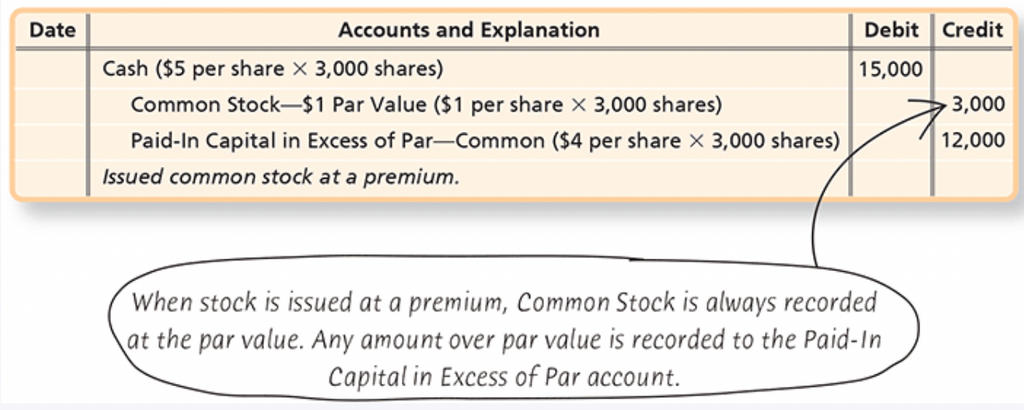
Journal Entry to issue stock at premieum.
-At a \$1 par value, a company issues 3,000 shares of stock at \$5 per share.
-At a \$1 par value, a company issues 3,000 shares of stock at \$5 per share.
'Paid-In Capital in Excess of Par' is a shareholders equity account
17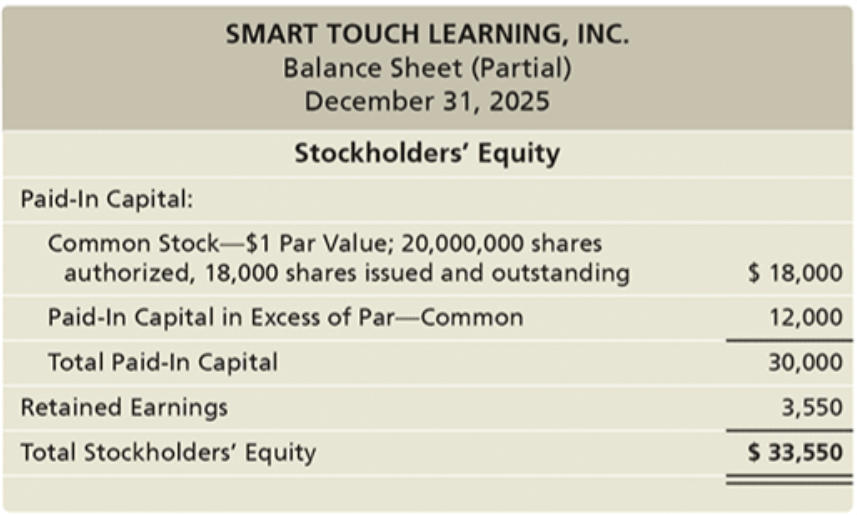
(Based on the past slide)
How would 'common stock' and 'Paid-in capital excess of par' be in the balance sheet?
How would 'common stock' and 'Paid-in capital excess of par' be in the balance sheet?
18
Journal Entry to issue common stock w/ no par-value
19
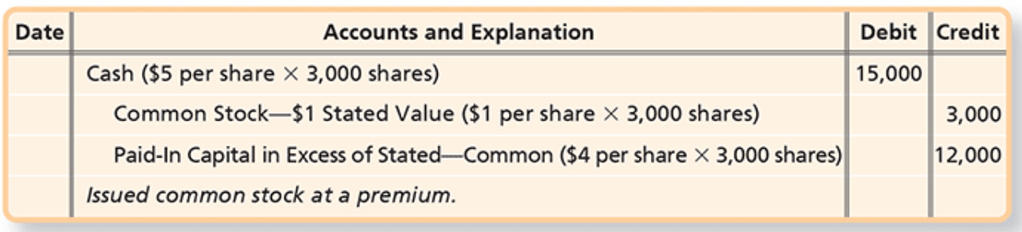
Journal Entry to issue 15,000 shares of stock at the stated-value of \$1.
(It is the EXACT same as if the par-value was \$1, excpet that it is 'excess of stated' and not 'excess of par' for that account name)
20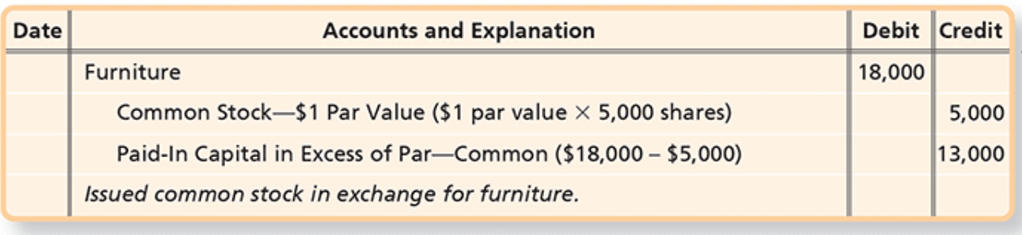
Journal Entry for tarding furniture worth \$18,000 in exchange fro 5,000 shares at a \$1 par value.
21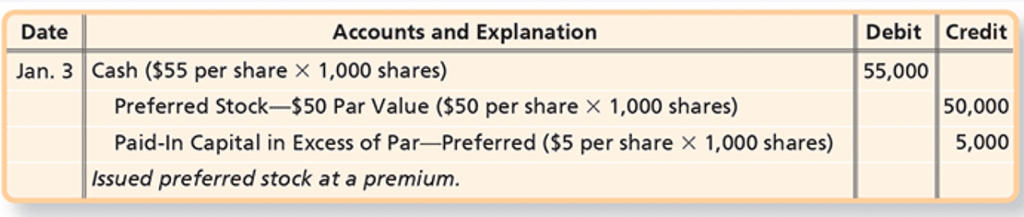
Journal Entry
-Issue 1,000 shares of preffered stock
-\$50 par value
-Issued at \$55 per share
-Issue 1,000 shares of preffered stock
-\$50 par value
-Issued at \$55 per share
22
Teasury Stock
Stock that the company has issued and then repurchased
23
Top 4 reasons companies would have Treasury Stock?
1. Management wants to increase net assets by buying low and selling high.
2. Management wants to support the company’s stock price.
3. Management wants to avoid a takeover by an outside party by reducing the number of outstanding shares that have voting rights.
4. Management wants to reward valued employees with stock.
2. Management wants to support the company’s stock price.
3. Management wants to avoid a takeover by an outside party by reducing the number of outstanding shares that have voting rights.
4. Management wants to reward valued employees with stock.
24
What type of account is 'Treasury Stock'?
It has a normal balance of debit, which is the oppsoite of the normal balance for equity accounts.
Therefore, it is a contra-equity account.
Therefore, it is a contra-equity account.
25
Journal Entry to purchase Treasury Stock
26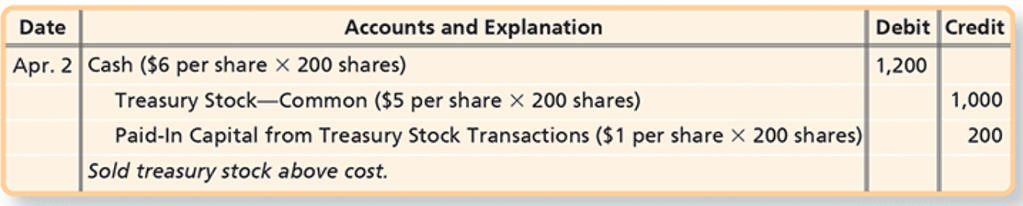
Journal Entry for a company to sell its Treasury stock for more than they bought it for.
-They sold it for 1,200
-They paid 1,000
-They sold it for 1,200
-They paid 1,000
27
Journal Entry for a company to sell its Treasury stock for less than they bought it for.
-They sold it for less than \$1,000
-They paid 1,000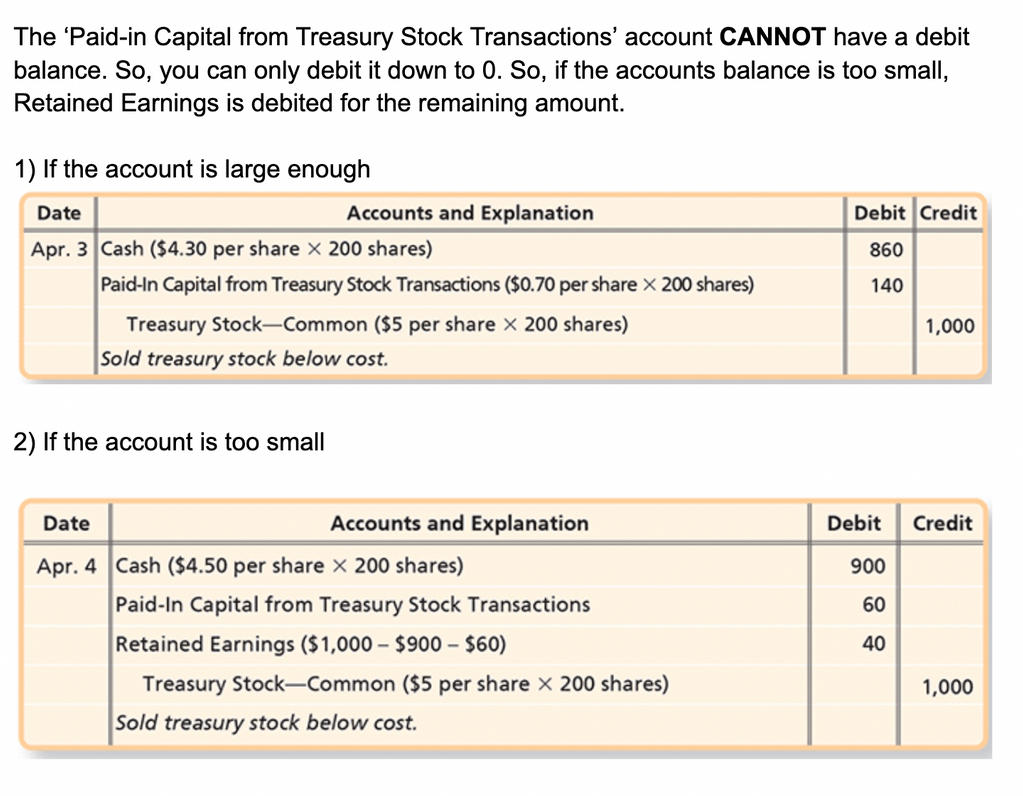
Journal Entry for a company to sell its Treasury stock for less than they bought it for.
-They sold it for less than \$1,000
-They paid 1,000
28
Can retired stock be reissued?
NO!
29
Legal Capital
The portion of stockholders' equity that cannot be used for dividends.
30
Three relevant dividend dates.
1. Declaration Date:
2. Date of Record:
3. Payment Date:
1. Declaration Date:
2. Date of Record:
3. Payment Date:
1. Declaration Date: On the declaration date—say, May 1—the board of directors announces the intention to pay the dividend. This creates a liability.
2. Date of Record: The date someone had purchased the dividend that makes them allowed to receive a dividend.
3. Payment Date: Date of payment of dividend
2. Date of Record: The date someone had purchased the dividend that makes them allowed to receive a dividend.
3. Payment Date: Date of payment of dividend
31
Jounral Entry for declaration date
-Company states they will give out \$1,135 of cash dividends
-Company states they will give out \$1,135 of cash dividends
Cash Dividends has a normal debit balance, meaning that it is a contra-equity account.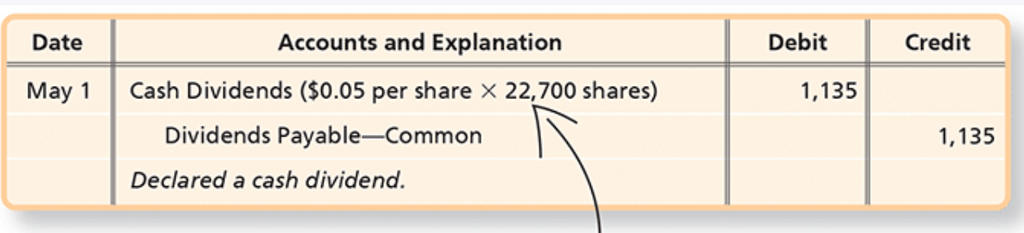
32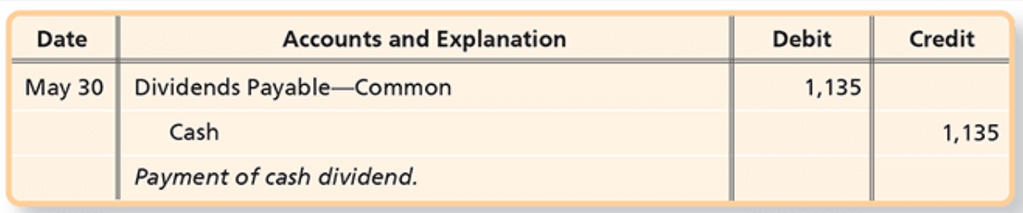
Journal Entry to pay the dividend
33
What happens to the cash dividends account?
It needs to be closed off at the end of the accounting perios through retained earnings.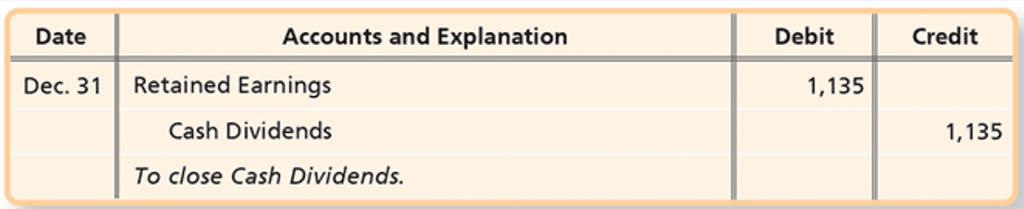
34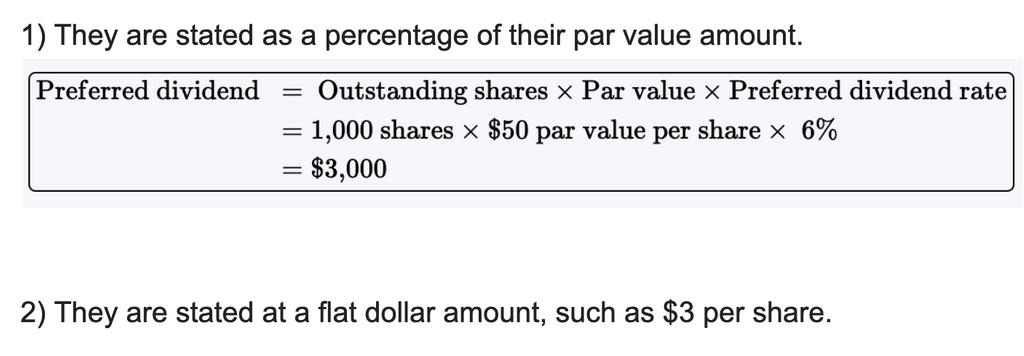
What are the two types of ways dividends are stated for preffered stocks?
35
"Dividend in Arrers"
A preferred stock dividend is in arrears if the dividend has not been paid for the year and the preferred stock is cumulative (meaning that they company must pay preferred shares the missed dividends before they can pay common stock dividends) .
36
Cumulative Prefferd Stock
Shareholders must receive all dividends in arrears plus the current year dividends before the common stockholders receive a dividend.
37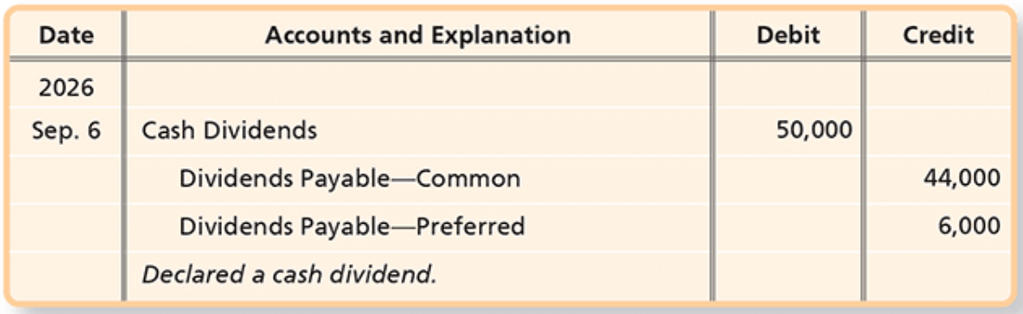
Journal Entry for declaration date
-Company states they will give out \$44,000 worth of cash for common stocks
-Company states they will give out \$6,000 worth of cash for preferred stocks
-Company states they will give out \$44,000 worth of cash for common stocks
-Company states they will give out \$6,000 worth of cash for preferred stocks
38
Top 3 reasons companies issue stock dividends
1. To continue dividends but conserve cash'
2. To reduce the market price per share of its stock
3. To reward investors
2. To reduce the market price per share of its stock
3. To reward investors
39
For stock dividends, on the delcaration date, is a liability created?
NO! (It does not giving up its assets, but rather just issueing new stock)
40
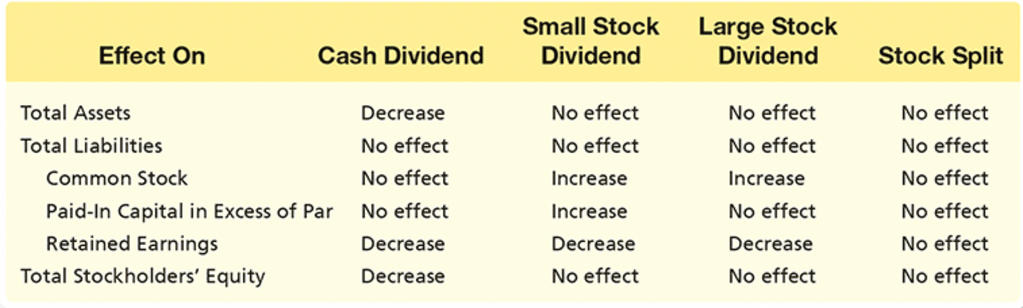
10% stock dividends means
If a person has 100,000 shares, a 10% stock dividend would give them 10,000 shares.
41
Two types
1) Small Stock Dividends
-20% - 25% of issued and outstanding stock
2) Large Stock Dividends
-greater than 20% - 25% of issued and outstanding stock
How does GAAP distinguish between the two types of stock dividneds.
Two types
1) Small Stock Dividends
-20% - 25% of issued and outstanding stock
2) Large Stock Dividends
-greater than 20% - 25% of issued and outstanding stock
42
Journal Entries to FULLY record small stock dividends .
-5% stock dividends
-Outstanding shares is \$50 of 2,000,0000 shares
-The par value per share is \$1.
-5% stock dividends
-Outstanding shares is \$50 of 2,000,0000 shares
-The par value per share is \$1.
It is record at the stocks market value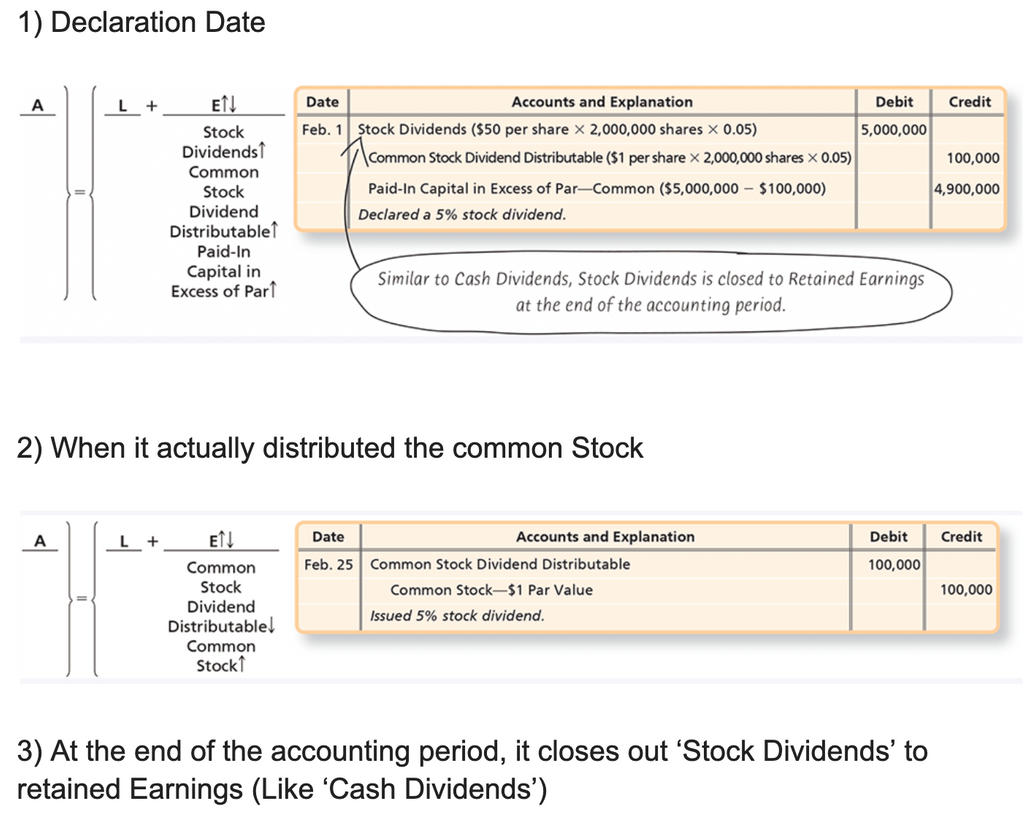
43
Journal Entries to FULLY record large stock dividends .
-5% stock dividends
-Outstanding shares is \$50 of 2,000,000 shares
-The par value per share is \$1.
-5% stock dividends
-Outstanding shares is \$50 of 2,000,000 shares
-The par value per share is \$1.
It is record at the stocks par value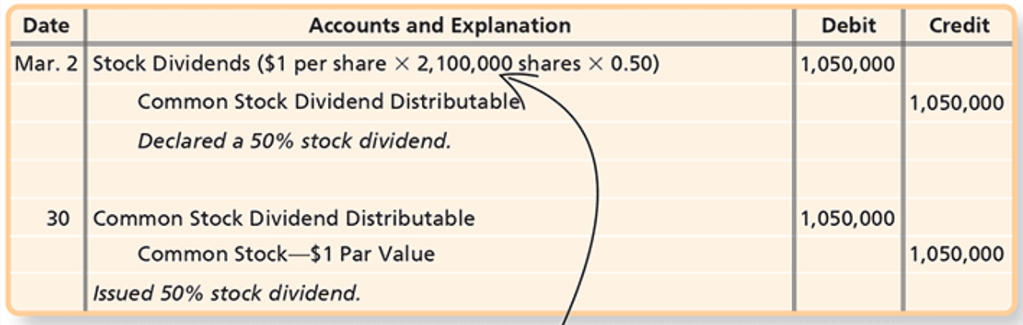
44
An increase in the number of outstanding shares of stock coupled with a proportionate reduction in the par value of the stock.
ex)
If a company wants to reduce its stock price from \$50 to \$25, they could do a '2 in 1 split' of its commons stock. This would double the amount of outstanding shares and would cut in half the par value.
The value of the account though would not change, and therefore would not require a journal entry.
However, it would require a memorandum entry which is a note in the journal to note a significant event, but does not have a credit or debit.
Stock Split
(also, how does it need to be recorded in the jounral?)
(also, how does it need to be recorded in the jounral?)
An increase in the number of outstanding shares of stock coupled with a proportionate reduction in the par value of the stock.
ex)
If a company wants to reduce its stock price from \$50 to \$25, they could do a '2 in 1 split' of its commons stock. This would double the amount of outstanding shares and would cut in half the par value.
The value of the account though would not change, and therefore would not require a journal entry.
However, it would require a memorandum entry which is a note in the journal to note a significant event, but does not have a credit or debit.
45
46
Income statment for corporations
1) Discoitnited operations are from when they sell or dispoe of an idetified divison of tge company.
2) Earnings per Share (EPS) is
(Net Income - Preferred Shares ) / Weighted average of common stocks outstanding
*To calculate the weighted avergae, you need to be i n advanced accounting courses.
The textbook just says for ismplicty to do (Beginning common stocks outstanding + Ending) /2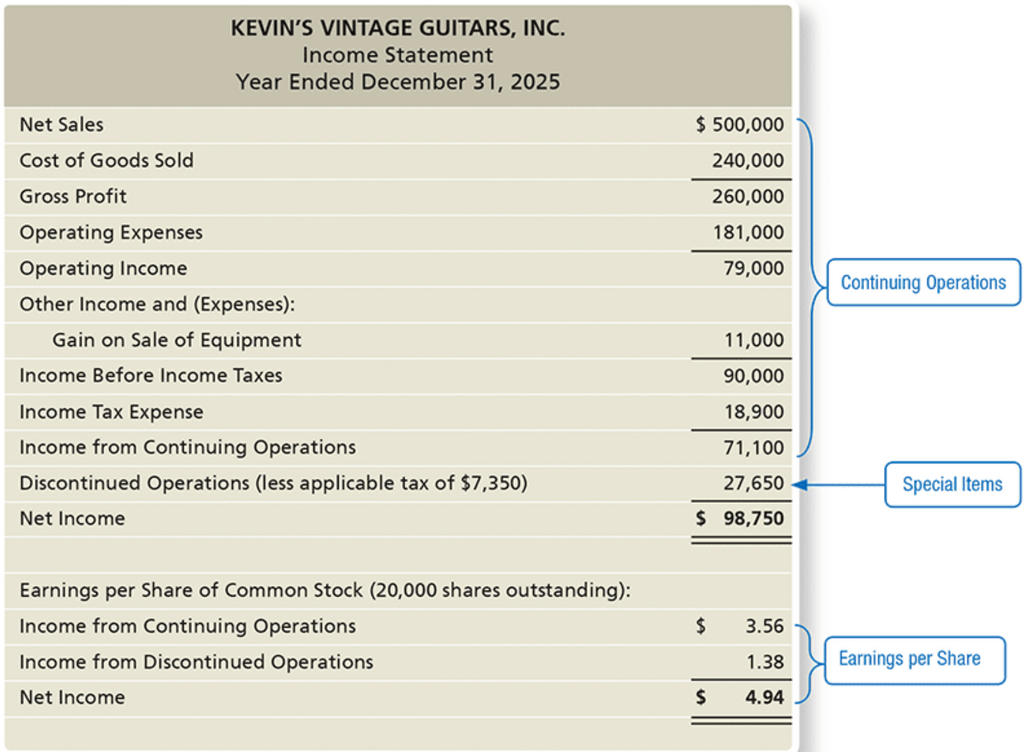
2) Earnings per Share (EPS) is
(Net Income - Preferred Shares ) / Weighted average of common stocks outstanding
*To calculate the weighted avergae, you need to be i n advanced accounting courses.
The textbook just says for ismplicty to do (Beginning common stocks outstanding + Ending) /2
47
Deficient
When the retained earnings account has a debit balance, meaning there is angetaive amount in the retained earnings account
48
'Apporpiations of Retained Earnings' meaning?
Restriction of a portion of retained earnings, that is recorded by a journal entry.
ex)
The board of directors may appropriate part of retained earnings for expansion
ex)
The board of directors may appropriate part of retained earnings for expansion
49
Prior-Period Adjustment
A correction to Retained Earnings for an error made to the prior period.
ex)
Lets say last period you accidetnely recorded salaries expense as \$30,000 instead of \$40,000.
This would cause Retained Earnings to be overstated by \$10,000
ex)
Lets say last period you accidetnely recorded salaries expense as \$30,000 instead of \$40,000.
This would cause Retained Earnings to be overstated by \$10,000
50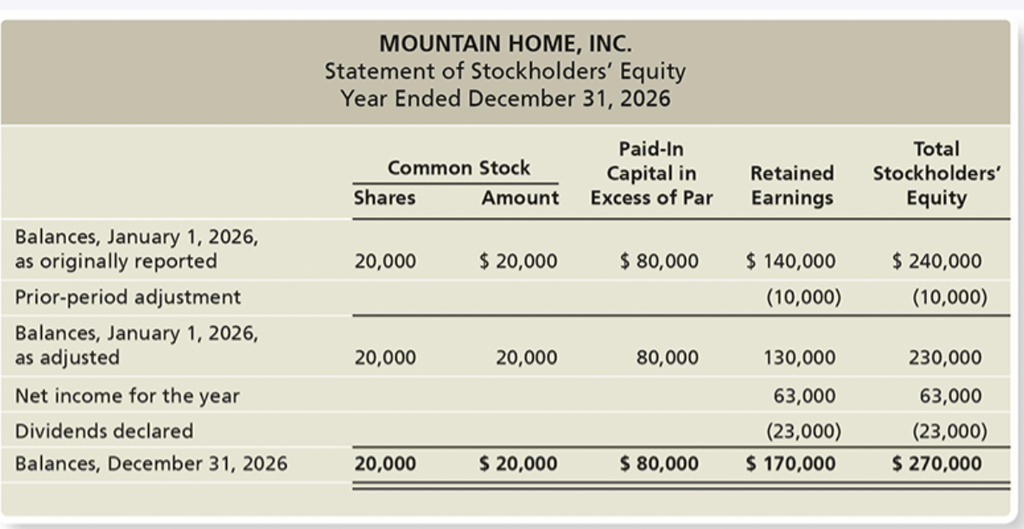
For exam (using my Flash cards as notes to put what I want on the exam)
51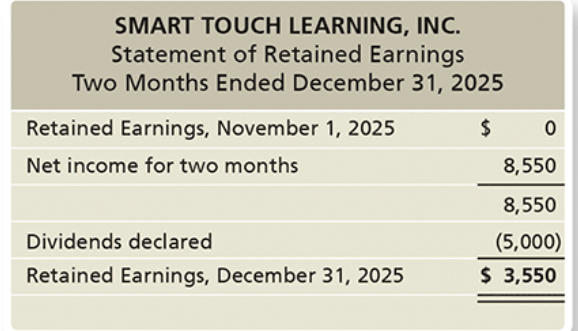
For exam (using my Flash cards as notes to put what I want on the exam).
52
Reports the amount of income (or loss) for each of the comapnies common stock outstanding shares
(Net Income - Preferred Shares) / Weighted Average of Common Stocks Outstanding
* "*To calculate the weighted average, you need to be in an advanced accounting course. The textbook just says for simplicity to do (Beginning common stocks outstanding + Ending) /2 "
EPS (Earnings Per Share)
Reports the amount of income (or loss) for each of the comapnies common stock outstanding shares
(Net Income - Preferred Shares) / Weighted Average of Common Stocks Outstanding
* "*To calculate the weighted average, you need to be in an advanced accounting course. The textbook just says for simplicity to do (Beginning common stocks outstanding + Ending) /2 "
53
Investors are paying \$31 for every \$1 the company earns per year
Low P/E ratio: Market thinks its slow growth
High P/E ratio: Market thinks strong future growth
Price/Earnings Ratio
Investors are paying \$31 for every \$1 the company earns per year
Low P/E ratio: Market thinks its slow growth
High P/E ratio: Market thinks strong future growth
54
Rate of Return on Common Stockholders’ Equity
The company makes \$0.51 profit for every \$1 shareholders have invested.
55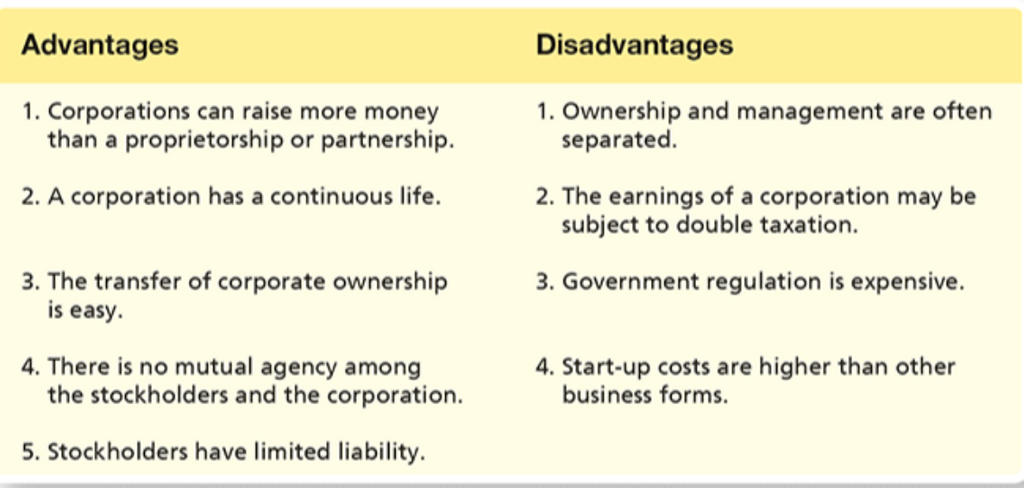
Advantages and disadvantegs of corproations
56
Which is listed first, preffered or common stock in the balaance sheet?
Preferred is First and Common stock is second.
Mehr Karteikarten: Wirtschaft
National incomeWirtschaft · Englischeinem OutLearn-StudierendenMGTM 339 Final Exam PrepWirtschaft · EnglischEthanIAS 2 InventoriesWirtschaft · EnglischEllaIFRS 5 Assets held for sale and discontinued operationsWirtschaft · EnglischEllaEconomics Unit 3 AOS 1Wirtschaft · EnglischRex.Business Structures: Sole ProprietorshipWirtschaft · EnglischSuveerBA 11: Introduction to Management and MarketingWirtschaft · EnglischJanineBusiness ActivityWirtschaft · EnglischHriteshECON Exam 2Wirtschaft · EnglischJosh4 Role of the Marketing PlanWirtschaft · EnglischJohnFin 332 Midterm Chaps 3-4Wirtschaft · Englischmattmc03Chapter 4 Vocab - Global BusinessWirtschaft · Englischbevo612
Lerne diese Decks in der App
Kostenlos auf iPhone, Android, Mac und im Web. Füge jedes Deck mit einem Tipp zu deinem Konto hinzu.

