Neutrophil Functions and Mechanisms
Diese Karteikarten lernenKostenlos · Spaced Repetition · iPhone, Android, Mac & Web
Alle Karten
1
How does oxygen-independent bacterial killing occur?
Through antimicrobial proteins such as defensins, cathepsins, and BPI.
2
What is the respiratory burst?
Activation of NADPH oxidase to rapidly produce bactericidal reactive oxygen species (ROS).
3
What are major ROS produced during the respiratory burst? How do ROS kill bacteria?
1. Superoxide O2-, hydrogen peroxide H2O2, hydroxyl radicalsOH, and singlet oxygen O2.
2. They damage proteins and oxidize lipids.
2. They damage proteins and oxidize lipids.
4
What does myeloperoxidase (MPO) do in neutrophils?
Uses H₂O₂ and halide to produce highly bactericidal hypochlorous acid (HOCl).
5
What are the two types of NETosis?
Suicidal and vital NETosis.
6
What determines the number and maturity of neutrophils found in blood?
The size of neutrophil pools and the rate of movement between them.
7
What are the three major bone marrow neutrophil compartments?
Progenitor, proliferative, and maturation-storage pools.
8
What happens in the neutrophil proliferative pool?
Precursors undergo mitosis to increase neutrophil numbers.
9
About what percentage of marrow neutrophil precursors are in the proliferative pool?
About 20%.
10
What happens in the maturation-storage pool?About what percentage of marrow neutrophil precursors are in the maturation-storage pool? Which species has the largest neutrophil storage pool?
1. Neutrophils mature without mitosis and are stored until release.
2. 80%
3. Dogs
2. 80%
3. Dogs
11
Which neutrophils are normally released from marrow first?
The oldest and most mature neutrophils.
12
What is the marginal pool (MP)? Blood
Neutrophils temporarily located along small-vessel walls that can attach, roll, and detach.
13
Are marginal-pool neutrophils measured on a CBC?
No.
14
What is the circulating pool (CP)?
Neutrophils flowing freely in the center of blood vessels.
15
Which neutrophil blood pool is sampled during phlebotomy?
The circulating pool.
16
How do the marginal and circulating pools compare in dogs, horses, and ruminants? How do the marginal and circulating pools compare in cats?
1. They are approximately equal in size.
2. The marginal pool is about 3 times larger than the circulating pool.
2. The marginal pool is about 3 times larger than the circulating pool.
17
What is the average transit time of neutrophils through blood?
About 8–10 hours.
18
How long do neutrophils normally survive in tissues?
About 1–4 days.
19
What happens to old apoptotic neutrophils in tissues?
They are removed by macrophages.
20
Neutrolphil Disease: What is purulent inflammation?
- Extravascular accumulation of neutrophils, producing pus.
21
What is the most common cause of neutrophilia?
Inflammation.
22
What can cause neutrophilic inflammation? (8 general things)
1. Infection
2. immune-mediated disease
3. necrosis
4. hemorrhage
5. hemolysis
6. neoplasia
7. foreign bodies
8. paraneoplastic cytokine production.
2. immune-mediated disease
3. necrosis
4. hemorrhage
5. hemolysis
6. neoplasia
7. foreign bodies
8. paraneoplastic cytokine production.
23
How does inflammation change neutrophil kinetics? (3)
It increases tissue use, marrow release, and marrow production while decreasing blood transit time T1/2.
24
What is the first bone marrow response to increased neutrophil demand? How quickly can increased marrow release affect the blood? Which mediators increase neutrophil release from bone marrow?
1. Increased release of stored neutrophils.
2. Within less than 1–2 days.
3. G-CSF, IL-1, TNF, and corticosteroids.
2. Within less than 1–2 days.
3. G-CSF, IL-1, TNF, and corticosteroids.
25
What is a left shift?
An increased number of immature neutrophils in the blood due to increased marrow release.
26
Why does a left shift occur? What does a left shift strongly indicate?
1. The mature storage pool becomes depleted, causing younger neutrophils to be released.
2. Inflammation with increased neutrophil demand.
2. Inflammation with increased neutrophil demand.
27
What is a regenerative left shift?
Mature neutrophils outnumber immature neutrophils.
28
What is a degenerative left shift?
Immature neutrophils outnumber mature neutrophils, often with neutropenia.
29
What does neutropenia with a degenerative left shift suggest in a dog?
Overwhelming inflammation with marrow storage-pool exhaustion and a poor prognosis.
30
Which species have large neutrophil storage pools? EXAM
Dogs, cats, and pigs.
31
Which domestic species have relatively small neutrophil storage pools? Why can these species develop neutropenia with a left shift early in severe inflammation?
1. Horses and ruminants.
2. Their small storage pools can be depleted rapidly.
2. Their small storage pools can be depleted rapidly.
32
Does early neutropenia with a left shift always mean marrow exhaustion in a horse?
No; it can occur because horses naturally have a small storage pool.
33
If a horse survives severe inflammation for 2–3 days, what may happen to its neutrophil count?
It may recover to normal or develop neutrophilia as marrow production increases.
34
What is the second marrow response to inflammation?
Increased effective granulopoiesis.
35
What is the slower but largest marrow response to inflammation?
Increased stem-cell/progenitor input driven by IL-3 and GM-CSF.
36
During inflammation, what ultimately determines the neutrophil count in blood?
The balance between marrow supply and tissue demand.
37
How do corticosteroids affect circulating neutrophil transit time?
They increase it by decreasing neutrophil adhesion.
38
What is a hypersegmented neutrophil? What is the most common cause of hypersegmented neutrophils in blood?
1. A neutrophil with 6 or more nuclear lobes.
2. Corticosteroid effects.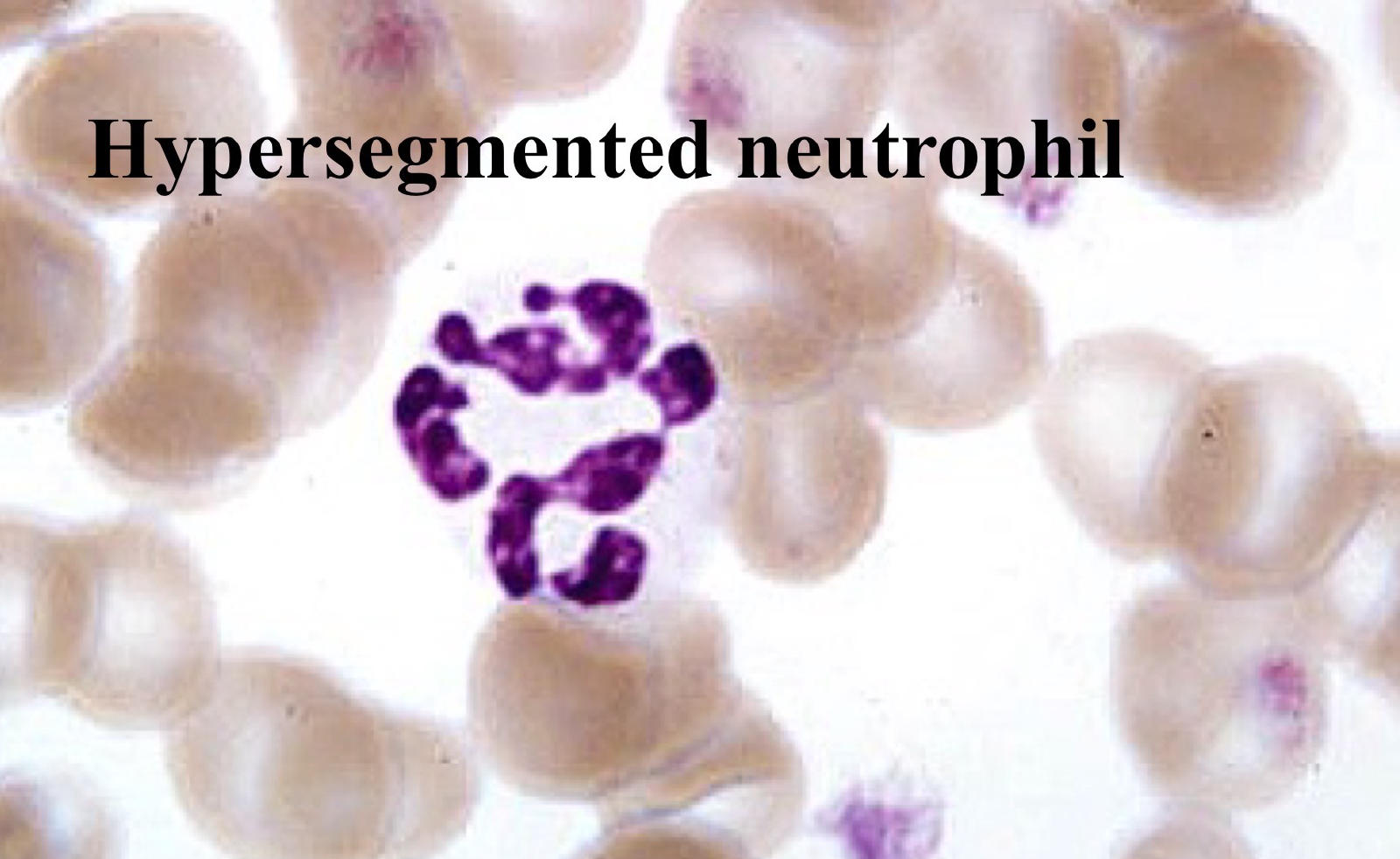
2. Corticosteroid effects.
39
What adhesion molecule is defective in leukocyte adhesion deficiency (LAD)?
β2 integrin (CD18).
40
How do epinephrine and corticosteroids shift neutrophil pools? How does endotoxin shift neutrophil pools?
1. They shift neutrophils toward the circulating pool.
2. It shifts neutrophils toward the marginal pool.
2. It shifts neutrophils toward the marginal pool.
41
A febrile dog has many bands but very few mature neutrophils. What type of left shift is present?
A degenerative left shift.
Mehr Karteikarten: Medizin und Gesundheit
Surgical Cartilage InterventionMedizin und Gesundheit · EnglischEshaKNES 259Medizin und Gesundheit · EnglischZanderPrefixesMedizin und Gesundheit · EnglischAlhajiReceptorsMedizin und Gesundheit · EnglischLoganWrist and HandMedizin und Gesundheit · EnglischEshaW1: Dental and Acne C/N/B/IMedizin und Gesundheit · EnglischVictorPolyneuropati (Nervebetændelse)Medizin und Gesundheit · DänischPresegoogle docs week 3Medizin und Gesundheit · Englischjocyt9BIOS 3753 Anatomy TerminologyMedizin und Gesundheit · EnglischNoodlesForBrainsScribeAmerica Medical TerminologyMedizin und Gesundheit · EnglischsserenieeWBC Lecture 3: Myeloproliferative disorders, FCMMedizin und Gesundheit · EnglischkarebearEndocrine Drug Classes and UsesMedizin und Gesundheit · EnglischAvery
Alle Decks: Medizin und Gesundheit
Lerne diese Decks in der App
Kostenlos auf iPhone, Android, Mac und im Web. Füge jedes Deck mit einem Tipp zu deinem Konto hinzu.

