Hemostasis and Coagulation Testing
Diese Karteikarten lernenKostenlos · Spaced Repetition · iPhone, Android, Mac & Web
Alle Karten
1
What are the major causes of abnormal bleeding considered in this lecture?
Trauma, thrombocytopenia, platelet dysfunction, vasculopathy, and coagulopathy.
2
Which anticoagulant is most commonly used for coagulation testing?
Sodium citrate in a blue-top tube.
3
What is the correct citrate-to-blood ratio for coagulation testing?
1 part citrate to 9 parts blood.
4
Why is a clean blood draw important for coagulation testing?
Difficult collection can activate platelets and introduce tissue factor, altering results.
5
What are the intrinsic, extrinsic, and common coagulation pathways? EXAM
Intrinsic: 12, 11, 9, 8; extrinsic: tissue factor and 7; common: 10, 5, 2, 1, 13.
6
How quickly should plasma be separated after collection for coagulation testing?
Within 1 hour after collection, after confirming the sample contains no clots.
7
How quickly should separated plasma be tested, and what if testing is delayed?
Ideally within 4 hours; freeze plasma if a longer delay is expected.
8
What is activated clotting time (ACT)?
A test measuring the time required for unanticoagulated whole blood to clot after intrinsic pathway activation.
9
What are the normal ACT ranges given for dogs and cats?
Dogs: 55–80 seconds; cats: 55–85 seconds.
10
What does prolonged ACT indicate?
Severe intrinsic or common pathway factor deficiency; it is relatively insensitive and usually requires factor activity below 10%.
- severe thrombocytopenia will delay, missing phospholipids
- severe thrombocytopenia will delay, missing phospholipids
11
What is activated partial thromboplastin time (aPTT/PTT)? Which coagulation pathways does aPTT evaluate?
1. The clotting time of citrated plasma after adding an intrinsic pathway activator, calcium, and phospholipids.
2. Intrinsic and common pathways.
2. Intrinsic and common pathways.
12
Does thrombocytopenia prolong aPTT?
No; aPTT is performed on plasma and is not affected by platelet count.
13
What is prothrombin time (PT)? Which coagulation pathways does PT evaluate?
1. The time required for citrated plasma to clot after adding tissue factor, calcium, and phospholipids.
2. Extrinsic and common pathways.
2. Extrinsic and common pathways.
14
What does prolonged PT indicate?
Deficiency or dysfunction of extrinsic or common pathway coagulation factors.
15
What is INR?
A unitless ratio used to standardize PT values, calculated as patient PT divided by reference PT
16
How does vitamin K deficiency affect coagulation factors?
Factors 2, 7, 9, and 10 are inadequately carboxylated and cannot function properly.
17
How is PIVKA indirectly evaluated in veterinary medicine?
Using modified PT or Thrombotest PT, which detects decreased activity of factors 2, 7, and 10.
18
What is thrombin time (TT or TCT)?
A test measuring clot formation after thrombin is added directly to citrated plasma.
19
What is the Clauss thrombin time assay used for?
Measuring functional fibrinogen concentration.
20
What conditions can prolong thrombin time?
Dysfibrinogenemia or inhibitors of fibrin polymerization, such as FDPs or paraproteins.
21
A young Yorkshire Terrier has a hematoma, normal platelets, prolonged aPTT, and normal PT and TCT. Which factor deficiency is most likely?
Factor 8 deficiency (hemophilia A).
22
What is viscoelastic testing?
A global hemostasis assessment that continuously measures clot formation, strength, and breakdown.
23
What do TEG reaction time (R) and ROTEM clotting time (CT) measure?
Time until the onset of fibrin polymerization.
24
How do R and CT change in hypercoagulability versus hypocoagulability?
Shortened in hypercoagulability; prolonged in hypocoagulability.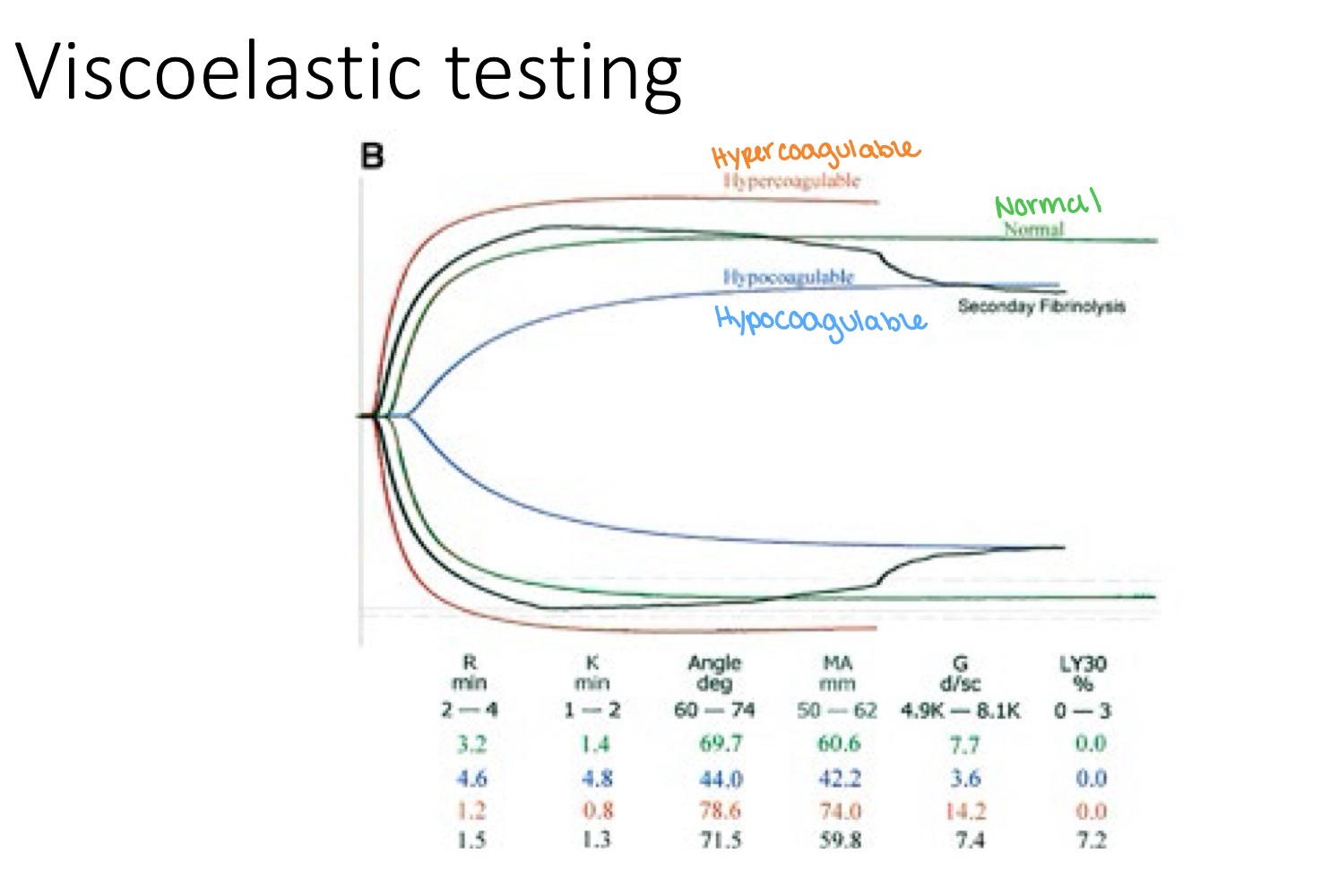
25
How are specific coagulation factor activities measured?
Modified PT/aPTT assays using factor-deficient plasma or chromogenic assays, reported as percentage activity.
26
A dog collapses with severe anemia and markedly prolonged PT and aPTT but relatively preserved platelets. Which cause is emphasized in the lecture case?
Vitamin K antagonism from anticoagulant rodenticide toxicity.
27
What is the function of plasmin?
Cleaves fibrinogen, soluble fibrin, and cross-linked fibrin during fibrinolysis.
28
What are fibrin/fibrinogen degradation products (FDPs)?
Products of fibrinogen or fibrin breakdown, commonly measured by immunoassays such as latex agglutination.
29
What can increased FDP concentrations indicate?
Hyperfibrinolysis, hyperfibrinogenolysis, or decreased clearance.
30
What are D-dimers?
Degradation products specifically produced when plasmin breaks down cross-linked fibrin.
31
What is the main distinction between FDPs and D-dimers?
FDPs reflect fibrinogen or fibrin breakdown; D-dimers specifically indicate breakdown of cross-linked fibrin.
32
What can increased D-dimers indicate?
Increased breakdown of cross-linked fibrin or decreased clearance; they do not independently confirm a specific disease.
33
Why is tPA sometimes added during viscoelastic fibrinolysis testing?
To stimulate measurable fibrinolysis and reduce analytical variability.
34
How is antithrombin (AT) activity measured?
A chromogenic assay using heparin, thrombin or factor 10a, and a color-producing substrate.
35
How does increasing antithrombin activity affect color production in its chromogenic assay?
More antithrombin inhibits more protease activity, producing less color.
36
What are the three major causes of decreased antithrombin activity?
Decreased production, increased loss, and increased consumption.
37
A dog has thrombocytopenia, prolonged PT/aPTT, low fibrinogen, low antithrombin, and high D-dimers. What mechanism is most likely?
Consumption of coagulation components, consistent with a consumptive coagulopathy such as DIC.
38
What five baseline tests are emphasized for evaluating suspected coagulopathy?
Platelet count, PT, aPTT, fibrinogen concentration, and D-dimers.
39
Why is hypercoagulability harder to identify than hypocoagulability?
Routine clotting assays primarily detect delayed clot formation rather than excessive clotting tendency.
Mehr Karteikarten: Medizin und Gesundheit
GI and GU Drug Classes and UsesMedizin und Gesundheit · EnglischAveryLecture 10 - Therex part IIMedizin und Gesundheit · EnglischEshaMusculoskeletal Medications: Generic and Brand NamesMedizin und Gesundheit · LateinebradstreetBipolar Disorder DrugsMedizin und Gesundheit · EnglischAveryčutilaMedizin und Gesundheitemaksillar ateş ölçümüMedizin und Gesundheit · TürkischNurMicosis Raras y OportunistasMedizin und Gesundheit · SpanischMajoLEC 21 BIOL 431Medizin und Gesundheit · EnglischDDFLCAntibiotics IMedizin und Gesundheit · EnglischcathsimsCardiovascular HistologyMedizin und Gesundheit · EnglischKrisMedCardsscapular regionMedizin und Gesundheit · Englischeinem OutLearn-Studierenden04: The Muscular SystemMedizin und Gesundheit · EnglischAndrew
Alle Decks: Medizin und Gesundheit
Lerne diese Decks in der App
Kostenlos auf iPhone, Android, Mac und im Web. Füge jedes Deck mit einem Tipp zu deinem Konto hinzu.

