Drug Elimination and Metabolism
Diese Karteikarten lernenKostenlos · Spaced Repetition · iPhone, Android, Mac & Web
Alle Karten
1
What is drug elimination?
Removal of a drug from plasma, resulting in decreased plasma drug concentration; irreversible
2
What are the two main components of drug elimination?
Metabolism and excretion.
3
What is drug metabolism (biotransformation)?
What is drug excretion?
What is drug excretion?
1. Enzymatic chemical transformation of a drug into metabolites.
2. Removal of a drug from the body without chemically changing the drug itself.
2. Removal of a drug from the body without chemically changing the drug itself.
4
What is the major purpose of drug metabolism?
To generally increase water solubility (hydrophilic) and facilitate elimination.
5
Why are lipophilic drugs often metabolized before elimination?
They cross membranes easily and can be reabsorbed rather than excreted.
6
How can enzyme inhibition cause drug toxicity?
It slows metabolism, allowing an active drug to accumulate.
7
What is a prodrug?
metabolism of inactive drug to active metabolite
8
What is the primary function of metabolic enzymes?
To speed up chemical reactions involved in drug transformation.
9
Why do metabolic enzymes exhibit substrate specificity?
Can one drug be metabolized by multiple enzymes?
Can one drug be metabolized by multiple enzymes?
1.Their binding sites recognize particular molecular structures.
2. Yes, potentially producing several different metabolites.
2. Yes, potentially producing several different metabolites.
10
What organs contain drug-metabolizing enzymes?
Primarily the liver, with extrahepatic metabolism also occurring.
11
What is the main purpose of Phase I metabolism?
To introduce or expose reactive functional groups.
- makes the compound more water soluble
- makes the compound more water soluble
12
What is the main purpose of Phase II metabolism?
To attach another chemical group, usually increasing polarity and water solubility.
13
Must every drug undergo Phase I before Phase II?
No. Some drugs undergo Phase II directly or are excreted without both phases.
14
What does the phenacetin-to-acetaminophen example illustrate?
Phase I can form an active drug, followed by Phase II conjugation for elimination.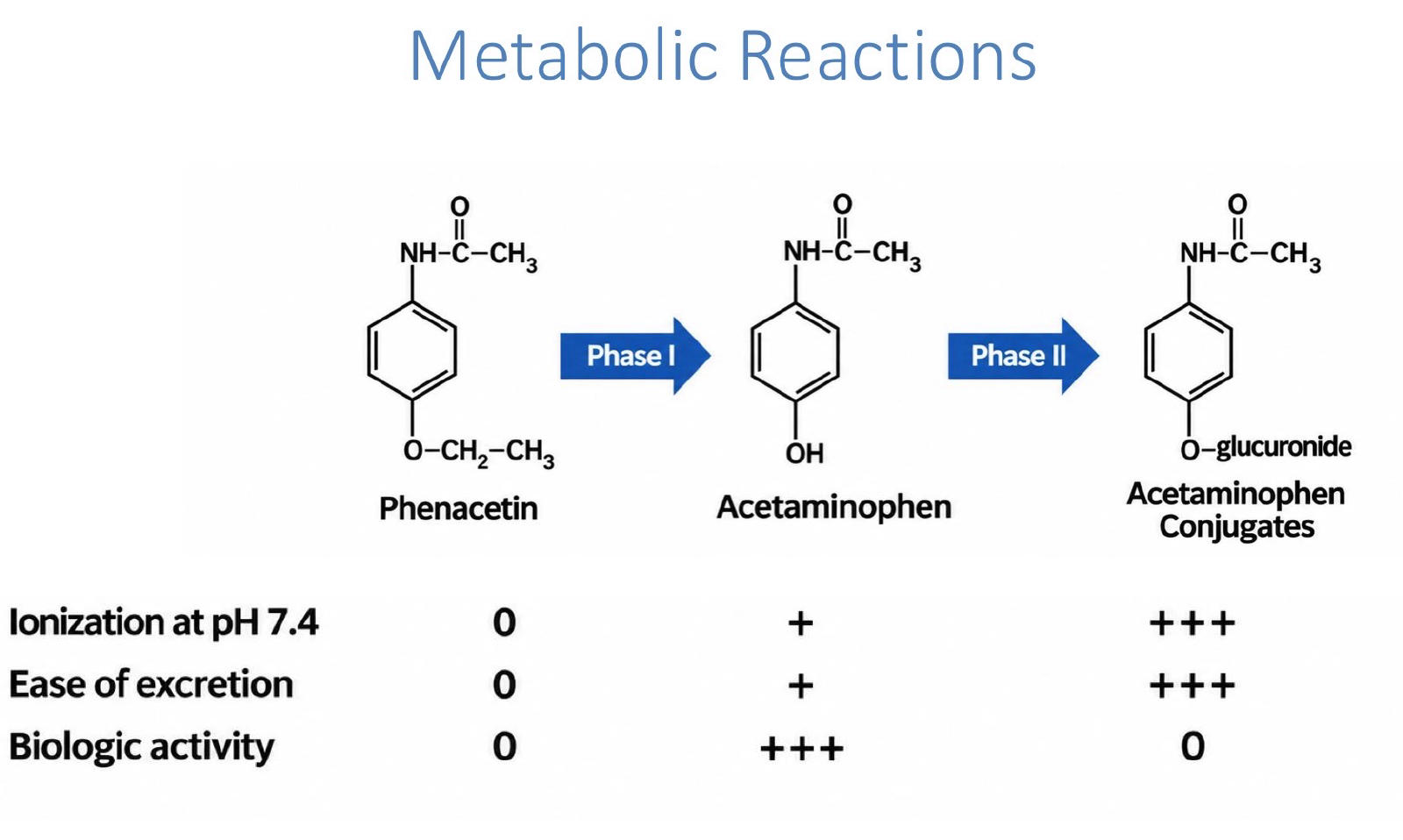
15
What are the three main types of Phase I reactions? EXAM
Oxidation, reduction, and hydrolysis.
16
What enzymes are especially important in Phase I oxidation? EXAM
Cytochrome P450 enzymes (CYP450) and flavin-containing monooxygenases.
17
What is the primary function of cytochrome P450 enzymes? Exam
Catalyze oxidative reactions that chemically modify drugs.
18
What type of reactions occur during Phase II metabolism?
What happens during a ____ reaction?
What happens during a ____ reaction?
1. Conjugation reactions.
2. A chemical group or molecule is attached to a drug or metabolite.
2. A chemical group or molecule is attached to a drug or metabolite.
19
How does Phase II metabolism usually affect drug polarity?
It produces more polar, often highly ionized metabolites.
20
What are the six major Phase II reactions listed in the lecture?
Glucuronidation, sulfation, glutathione conjugation, acetylation, amino acid conjugation, and methylation.
21
What happens during glucuronidation? UGTs
A glucuronosyl group is attached to a drug or metabolite.
22
Why does glucuronidation usually promote elimination?
It increases polarity and often makes metabolites more water-soluble.
- requires UDPGA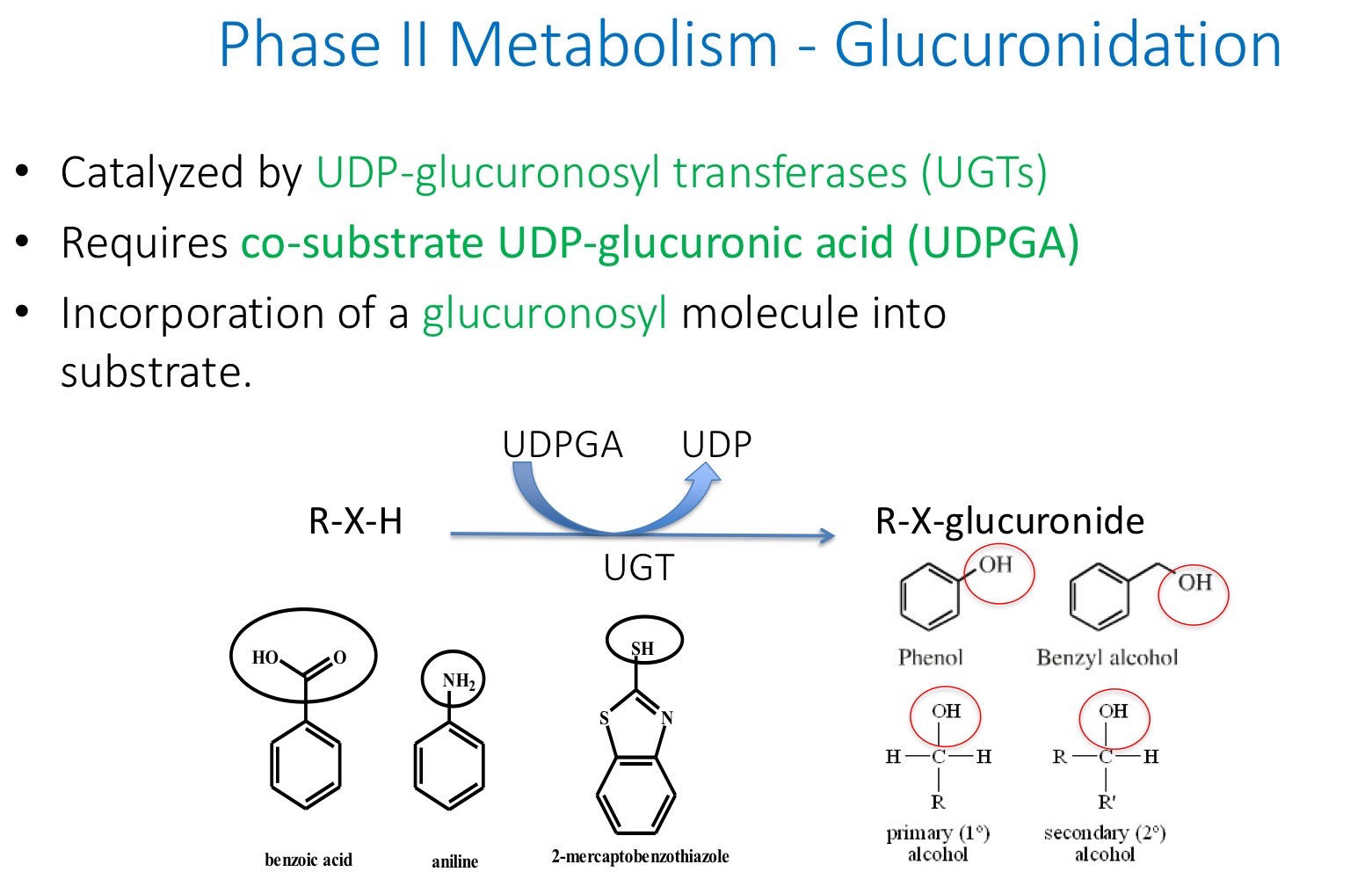
- requires UDPGA
23
What enzyme catalyzes sulfation?
What co-substrate is required for sulfation?
What happens during sulfation?
What co-substrate is required for sulfation?
What happens during sulfation?
1. Sulfotransferase (SULT).
2. PAPS (3′-phosphoadenosine-5′-phosphosulfate).
3. A sulfate group is transferred onto a drug or metabolite.
2. PAPS (3′-phosphoadenosine-5′-phosphosulfate).
3. A sulfate group is transferred onto a drug or metabolite.
24
What enzyme catalyzes glutathione conjugation?
What is the main purpose of glutathione conjugation?
What is the main purpose of glutathione conjugation?
1. Glutathione transferase (GST).
2. To bind reactive electrophilic metabolites and promote detoxification.
2. To bind reactive electrophilic metabolites and promote detoxification.
25
Presence of mercapturic acids in the urine signify that
a reactive metabolite was formed
26
What enzyme catalyzes acetylation?
What co-substrate is required for acetylation?
What co-substrate is required for acetylation?
1. N-acetyltransferase (NAT).
2. Acetyl-CoA; transfer of an acetyl group
2. Acetyl-CoA; transfer of an acetyl group
27
Does acetylation always increase water solubility?
No. Acetylated metabolites are not necessarily more water-soluble.
28
Which Phase II metabolic pathway is limited in cats?
Which other species has limitations in glucuronidation?
Which other species has limitations in glucuronidation?
Certain forms of glucuronidation are missing.
Ferrets
Ferrets
29
Which Phase II metabolic pathway is absent in dogs and foxes according to the lecture?
Acetylation.
30
Which Phase II pathway is slow in pigs?
Sulfation.
31
Why may drugs requiring glucuronidation persist longer in cats?
Reduced glucuronidation can decrease metabolism and subsequent elimination.
32
According to the lecture, which species has a much longer salicylate half-life than horses or cows?
Cats; approximately 37.6 hours versus 1.0 hour in horses and 0.54 hours in cows.
33
Does Phase II metabolism always inactivate a drug?
No. Some Phase II reactions produce active metabolites.
34
What is hepatic clearance?
The volume of plasma completely cleared of a drug by the liver per unit time.
35
What is the hepatic extraction ratio (ER)?
The fraction of drug removed by the liver during a single pass through it.
36
What is the formula for hepatic clearance?
Hepatic clearance = hepatic blood flow × hepatic extraction ratio.
37
What three major factors influence hepatic clearance?
Extraction ratio, hepatic blood flow, and plasma protein binding.
38
What is considered a high-extraction-ratio drug?
What mainly determines clearance of high-extraction-ratio drugs?
What mainly determines clearance of high-extraction-ratio drugs?
1. A drug with a hepatic extraction ratio greater than 0.7.
2. Hepatic blood flow; they are flow-dependent.
2. Hepatic blood flow; they are flow-dependent.
39
Do moderate changes in metabolic enzyme activity strongly affect high-ER drug clearance?
Usually not; hepatic blood flow is the major limiting factor.
40
What is considered a low-extraction-ratio drug?
What mainly determines clearance of low-ER drugs?
What mainly determines clearance of low-ER drugs?
1. A drug with a hepatic extraction ratio less than 0.3.
2. Metabolic and biliary elimination capacity; they are capacity-limited.
2. Metabolic and biliary elimination capacity; they are capacity-limited.
41
How do moderate changes in hepatic blood flow affect low-ER drugs?
They generally have little effect on hepatic clearance.
42
Would a high-ER drug generally have high or low oral bioavailability?
Low, because extensive first-pass hepatic extraction removes much of the drug.
43
Would a low-ER drug generally have high or low oral bioavailability?
High, because relatively little drug is removed during first-pass hepatic extraction.
44
What is metabolic enzyme induction?
Increased synthesis of drug-metabolizing enzymes, increasing metabolic capacity.
Approximately 7–14 days.
Approximately 7–14 days.
45
What is self-induction?
A drug increases the activity of enzymes responsible for its own metabolism.
46
How does enzyme induction usually affect an active drug that is metabolized into inactive products?
Faster metabolism decreases drug exposure and may reduce its therapeutic effect.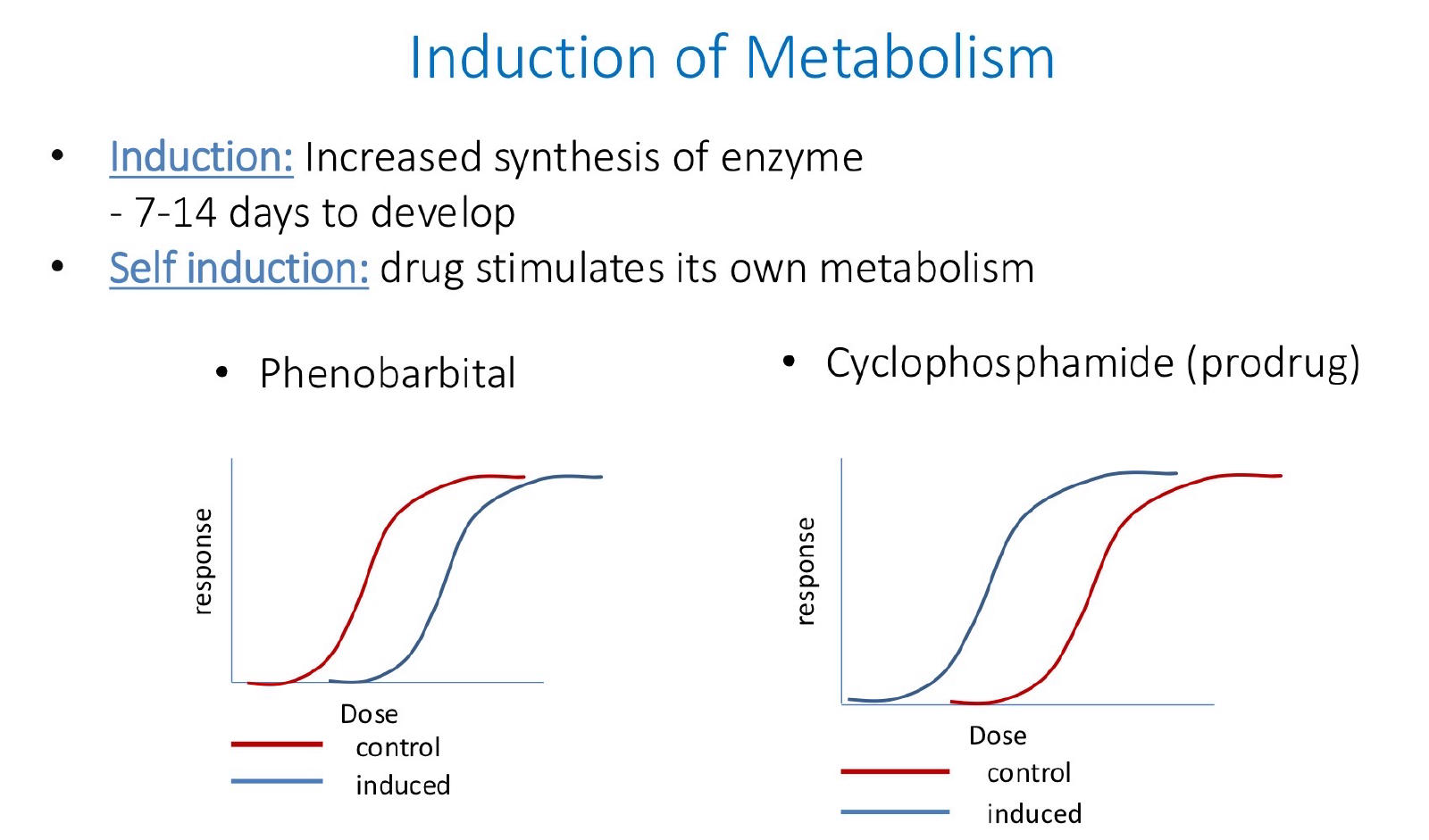
47
Why might enzyme induction require increasing the dose of some drugs?
Induced enzymes eliminate the active drug faster, potentially lowering therapeutic concentrations.
48
How can enzyme induction affect a prodrug?
It may increase formation of the active metabolite and intensify drug effects.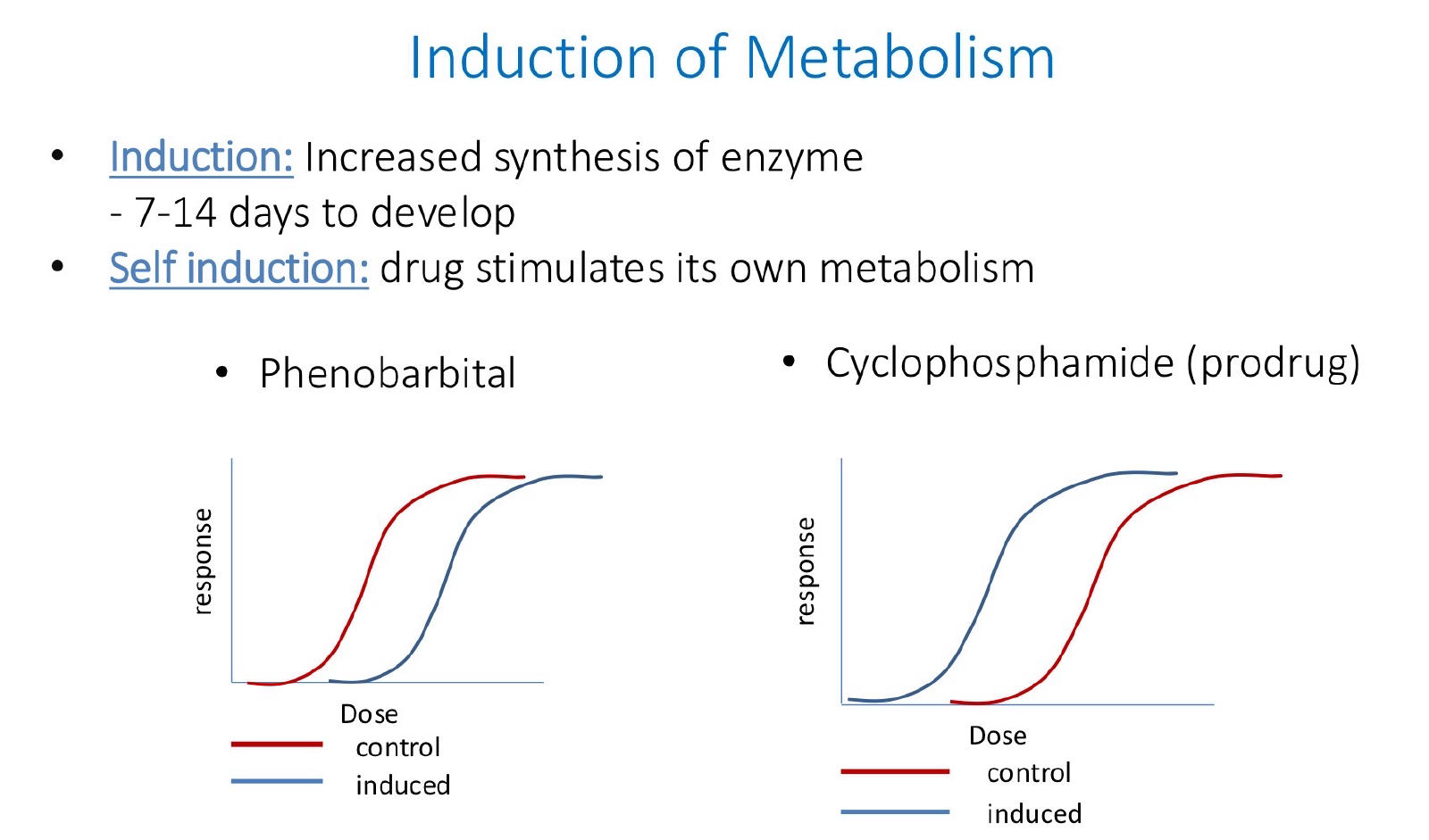
49
How can ethanol increase acetaminophen toxicity in the lecture's example?
Induction of CYP2E1 can increase formation of toxic NAPQI.
50
What is metabolic enzyme inhibition?
Reduced enzyme activity that decreases the metabolism of affected drugs.
51
What is competitive enzyme inhibition?
An inhibitor competes with the substrate for the enzyme's active site.
52
What is noncompetitive enzyme inhibition?
An inhibitor binds away from the active site and alters enzyme function.
53
How does enzyme inhibition usually affect clearance of an active drug?
Clearance decreases, potentially increasing plasma concentration and toxicity.
54
What is the key difference between enzyme induction and inhibition?
Induction increases metabolic enzyme capacity; inhibition decreases enzyme activity.
Mehr Karteikarten: Medizin und Gesundheit
GRAM NEGATIVE COCCI AND COCCOBACILLIMedizin und Gesundheit · EnglischAllissaHand series radiographyMedizin und Gesundheit · EnglischCovcovMusculoskeletal HA Exam #4Medizin und Gesundheit · EnglischMadiruth2pathologie infectieuse à prévention vaccinale Medizin und Gesundheit · FranzösischClaraLympathicMedizin und Gesundheit · EnglischEliazarArm 2 Origins and InsertionsMedizin und Gesundheit · EnglischKrisMedCardstuberculose, grippe et pneumopathieMedizin und Gesundheit · FranzösischClaraCancérologie : Gènes et modèles d'étudeMedizin und Gesundheit · FranzösischOcéaneCCRN Medizin und Gesundheit · Englischeinem OutLearn-StudierendenPHARMACY ORGANIZATIONS PART 2Medizin und Gesundheit · EnglischLlancePain ManagementMedizin und Gesundheit · EnglischCoryLecture 1_Immunodeficiency_pt1: disease & lab diagnosis Medizin und Gesundheit · Englischkarebear
Alle Decks: Medizin und Gesundheit
Lerne diese Decks in der App
Kostenlos auf iPhone, Android, Mac und im Web. Füge jedes Deck mit einem Tipp zu deinem Konto hinzu.

