Part IIB P1 Microeconomics: Applied Welfare Economics Part C.
Diese Karteikarten lernenKostenlos · Spaced Repetition · iPhone, Android, Mac & Web
Alle Karten
1
What is the opportunity cost of a choice?
1. The net benefit forgone from the best feasible alternative ruled out by that choice.
2. Net benefit means the alternative's benefit minus the costs you avoid by not taking it.
2. Net benefit means the alternative's benefit minus the costs you avoid by not taking it.
2
What are the consumer's optimality conditions in the SCBA benchmark?
1. Maximise $U(x_1,x_2)$ subject to $q_1x_1+q_2x_2=m$.
2. At an interior optimum, $\frac{\partial U}{\partial x_i}=\lambda q_i$, for $i=1,2$.
3. $\lambda=\frac{\partial V}{\partial m}$ is the marginal utility of income.
2. At an interior optimum, $\frac{\partial U}{\partial x_i}=\lambda q_i$, for $i=1,2$.
3. $\lambda=\frac{\partial V}{\partial m}$ is the marginal utility of income.
3
What is the utilitarian SWF in the SCBA benchmark?
1. $SWF=\sum_{h=1}^{H}U^h$: equal weight on each person's utility.
2. With $H$ identical consumers, $SWF=HU$.
2. With $H$ identical consumers, $SWF=HU$.
4
What is the welfare test for a project in the SCBA benchmark?
1. Undertake it if and only if $\Delta SWF>0$.
2. Extra output $\Delta x_1>0$ requires resources diverted from good $2$, sacrificing $\Delta x_2>0$ per capita.
3. Compare the welfare benefit of extra good $1$ with the welfare cost of forgone good $2$.
2. Extra output $\Delta x_1>0$ requires resources diverted from good $2$, sacrificing $\Delta x_2>0$ per capita.
3. Compare the welfare benefit of extra good $1$ with the welfare cost of forgone good $2$.
5
What does a shadow price measure?
1. For an output: the marginal social welfare gained per additional unit supplied.
2. For an input: the marginal social welfare forgone elsewhere per additional unit used by the project.
3. Initially, these valuations are in welfare units per physical unit.
2. For an input: the marginal social welfare forgone elsewhere per additional unit used by the project.
3. Initially, these valuations are in welfare units per physical unit.
6
How do shadow prices determine whether a small project raises welfare?
1. The project adds $\Delta x_1>0$ and sacrifices $\Delta x_2>0$, both per capita.
2. $\Delta SWF\approx v_1\Delta x_1-v_2\Delta x_2$.
3. Undertake it if this is positive: social benefit exceeds social opportunity cost.
2. $\Delta SWF\approx v_1\Delta x_1-v_2\Delta x_2$.
3. Undertake it if this is positive: social benefit exceeds social opportunity cost.
7
How are output shadow prices derived in the utilitarian benchmark?
1. Each consumer gains $\frac{\partial U}{\partial x_j}$ utility per additional unit of good $j$.
2. With $H$ identical consumers, $SWF=HU$.
3. Thus $v_j=H\frac{\partial U}{\partial x_j}$ for an increase in per-capita consumption.
2. With $H$ identical consumers, $SWF=HU$.
3. Thus $v_j=H\frac{\partial U}{\partial x_j}$ for an increase in per-capita consumption.
8
Why can consumer prices determine the welfare verdict in this benchmark?
1. Consumer optimisation gives $\frac{\partial U}{\partial x_j}=\lambda q_j$, so $v_j=H\lambda q_j$.
2. Hence $v_1\Delta x_1-v_2\Delta x_2=H\lambda(q_1\Delta x_1-q_2\Delta x_2)$.
3. Since $H\lambda>0$, both expressions have the same sign: the project raises welfare if $q_1\Delta x_1-q_2\Delta x_2>0$.
2. Hence $v_1\Delta x_1-v_2\Delta x_2=H\lambda(q_1\Delta x_1-q_2\Delta x_2)$.
3. Since $H\lambda>0$, both expressions have the same sign: the project raises welfare if $q_1\Delta x_1-q_2\Delta x_2>0$.
9
How does a small project's input use determine forgone output?
1. Fixed factor supplies imply $\Delta l_0^2=-\Delta l_0^1$ and $\Delta k^2=-\Delta k^1$.
2. Thus $\Delta x_2\approx\frac{\partial F^2}{\partial l_0^2}\Delta l_0^1+\frac{\partial F^2}{\partial k^2}\Delta k^1$.
3. Each input diverted to the project sacrifices its marginal product in sector $2$.
2. Thus $\Delta x_2\approx\frac{\partial F^2}{\partial l_0^2}\Delta l_0^1+\frac{\partial F^2}{\partial k^2}\Delta k^1$.
3. Each input diverted to the project sacrifices its marginal product in sector $2$.
10
What are the input optimality conditions for a price-taking firm in sector $2$?
1. $p_2\frac{\partial F^2}{\partial l_0^2}=p_0$ and $p_2\frac{\partial F^2}{\partial k^2}=p_k$.
2. Each input's marginal revenue product equals its price.
2. Each input's marginal revenue product equals its price.
11
When does the project's input bill measure the value of forgone consumption?
1. Substituting firms' optimality conditions gives $q_2\Delta x_2\approx\frac{q_2}{p_2}(p_0\Delta l_0^1+p_k\Delta k^1)$.
2. If $q_2=p_2$, this becomes $q_2\Delta x_2\approx p_0\Delta l_0^1+p_k\Delta k^1$.
3. Thus, for a small project in this competitive benchmark, the input bill measures the social opportunity cost.
2. If $q_2=p_2$, this becomes $q_2\Delta x_2\approx p_0\Delta l_0^1+p_k\Delta k^1$.
3. Thus, for a small project in this competitive benchmark, the input bill measures the social opportunity cost.
12
When can market values be used to assess a project's welfare effect?
1. In the benchmark: price-taking, no taxes or subsidies, no unpriced externalities, and a small project with no price effects.
2. Undertake it if $q_1\Delta x_1-(p_0\Delta l_0^1+p_k\Delta k^1)>0$.
2. Undertake it if $q_1\Delta x_1-(p_0\Delta l_0^1+p_k\Delta k^1)>0$.
13
What is a numeraire in SCBA?
1. The reference unit in which all benefits and costs are expressed.
2. Usually private income (money), though other choices are possible.
2. Usually private income (money), though other choices are possible.
14
How is a utility-unit shadow price converted into money?
1. Divide by $\lambda$, the marginal utility of income.
2. Under normalisation, $q_j^{SP}=\frac{v_j}{\lambda}=\frac{1}{\lambda}\frac{\partial U}{\partial x_j}$.
2. Under normalisation, $q_j^{SP}=\frac{v_j}{\lambda}=\frac{1}{\lambda}\frac{\partial U}{\partial x_j}$.
15
Why must benefits and costs use the same numeraire?
1. Values in different units cannot be meaningfully subtracted.
2. A consistent change of numeraire rescales net benefits without changing the welfare verdict.
2. A consistent change of numeraire rescales net benefits without changing the welfare verdict.
16
Why might market prices fail to reflect social value?
1. Market power distorts prices.
2. Taxes and subsidies create wedges between consumer and producer prices.
3. Uncorrected externalities leave social costs or benefits unpriced.
2. Taxes and subsidies create wedges between consumer and producer prices.
3. Uncorrected externalities leave social costs or benefits unpriced.
17
What further issues must SCBA address beyond the benchmark?
1. Missing markets: estimate shadow prices without observed market prices.
2. Unequal impacts: account for who gains and who loses.
3. Effects at different dates: use social discounting.
2. Unequal impacts: account for who gains and who loses.
3. Effects at different dates: use social discounting.
18
How does a project-induced increase in supply affect consumer surplus in an undistorted market?
1. The market price decreases from $q_1^0$ to $q_1^1$.
2. Consumer surplus increases by area $FABG$.
2. Consumer surplus increases by area $FABG$.
19
How does a project-induced increase in supply affect existing producers' surplus?
1. Existing producers move from $A$ to $C$ along their supply curve as the price decreases.
2. Their producer surplus decreases by area $FACG$.
3. The new project's revenue is accounted for separately.
2. Their producer surplus decreases by area $FACG$.
3. The new project's revenue is accounted for separately.
20
What is the net change in consumer and existing producer surplus in the Boardman diagram?
1. $\Delta CS=FABG$.
2. $\Delta PS=-FACG$.
3. $\Delta CS+\Delta PS=ABC$.
2. $\Delta PS=-FACG$.
3. $\Delta CS+\Delta PS=ABC$.
21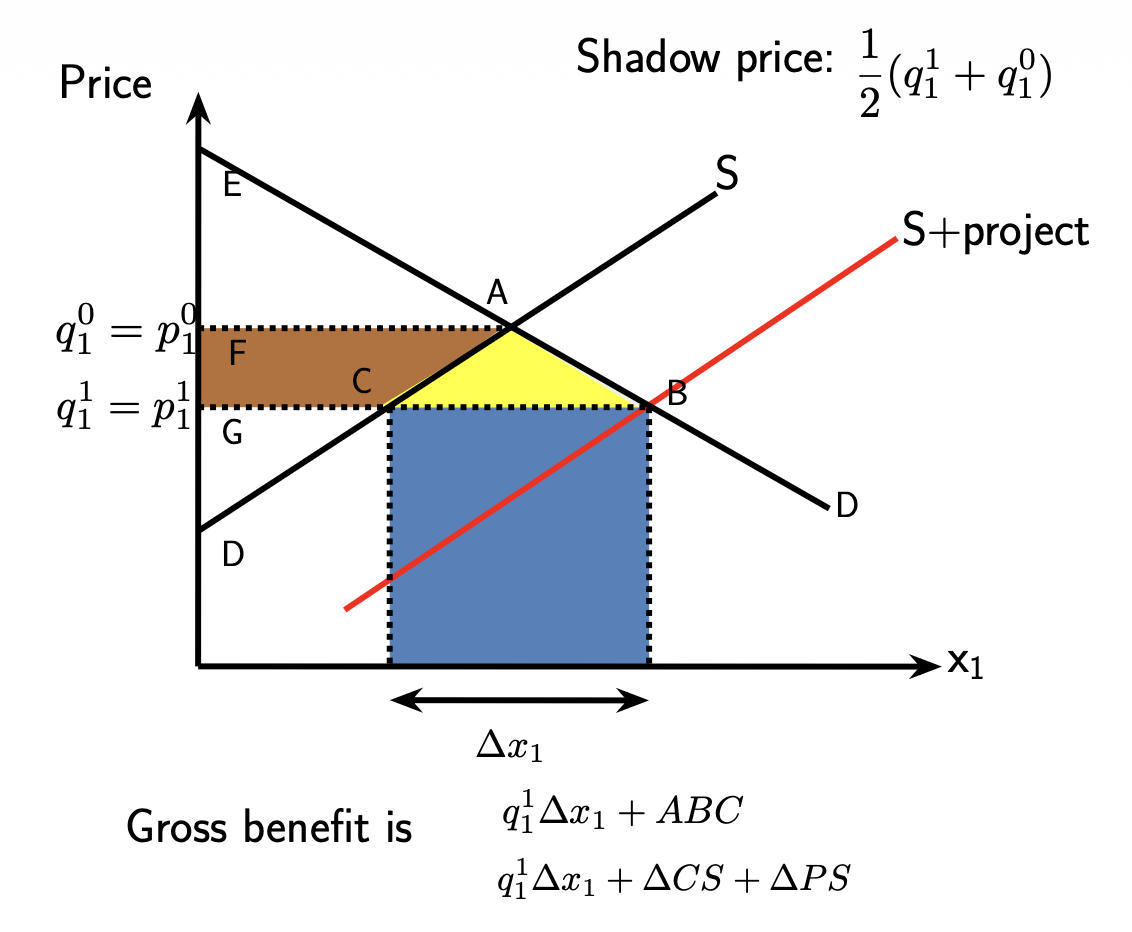
How does the Boardman diagram illustrate the changes in consumer surplus, existing producer surplus and net social surplus?
22
How is gross social benefit derived in the Boardman method?
1. $GSB=q_1^1\Delta x_1+\Delta CS+\Delta PS$.
2. $\Delta CS+\Delta PS=ABC=\frac12(q_1^0-q_1^1)\Delta x_1$.
3. $GSB=q_1^1\Delta x_1+\frac12(q_1^0-q_1^1)\Delta x_1$.
2. $\Delta CS+\Delta PS=ABC=\frac12(q_1^0-q_1^1)\Delta x_1$.
3. $GSB=q_1^1\Delta x_1+\frac12(q_1^0-q_1^1)\Delta x_1$.
23
How is the Boardman output shadow price derived in an undistorted market with linear demand and supply?
1. $q_1^{SP}=\frac{GSB}{\Delta x_1}$.
2. $q_1^{SP}=q_1^1+\frac12(q_1^0-q_1^1)$.
3. $q_1^{SP}=\frac12(q_1^0+q_1^1)$.
2. $q_1^{SP}=q_1^1+\frac12(q_1^0-q_1^1)$.
3. $q_1^{SP}=\frac12(q_1^0+q_1^1)$.
24
Why does the Boardman method use an average shadow price?
1. A finite project changes market prices, so marginal valuations differ across units.
2. The average shadow price values the entire output: $q_1^{SP}\Delta x_1=GSB$.
3. For negligible price changes, $q_1^{SP}\approx q_1^0$.
2. The average shadow price values the entire output: $q_1^{SP}\Delta x_1=GSB$.
3. For negligible price changes, $q_1^{SP}\approx q_1^0$.
25
Why do small price changes have no first-order welfare effect in an undistorted competitive market?
1. $x_1$: Consumer demand; $y_1$: Producer supply.
2. Market clearing implies $x_1=y_1$.
3. Consumer and producer surplus effects cancel to first order.
2. Market clearing implies $x_1=y_1$.
3. Consumer and producer surplus effects cancel to first order.
26
Why can pre-project prices approximate shadow prices for small projects?
1. Small price changes generate only second-order net surplus effects.
2. Hence, pre-project prices provide a first-order approximation to shadow prices.
2. Hence, pre-project prices provide a first-order approximation to shadow prices.
27
What is the practical difficulty of estimating Boardman shadow prices for large projects?
1. The post-project market price is unobserved.
2. Estimating it requires information on demand and supply elasticities.
2. Estimating it requires information on demand and supply elasticities.
28
Why can small price changes affect welfare in a market with a pre-existing sales tax?
1. Consumer and existing-producer surplus effects cancel to first order.
2. Changes in consumption alter government tax revenue.
3. Hence, $\frac{\Delta V}{\lambda}\approx t_1\Delta X$, where $\Delta X$ is the change in consumption.
2. Changes in consumption alter government tax revenue.
3. Hence, $\frac{\Delta V}{\lambda}\approx t_1\Delta X$, where $\Delta X$ is the change in consumption.
29
How is gross social benefit calculated for a small project in a market with a sales tax?
1. $GSB\approx p_1\Delta G+t_1\Delta X$.
2. $\Delta G$: Additional project output; $\Delta X$: Increase in total consumption.
3. The terms represent project receipts and additional tax revenue.
2. $\Delta G$: Additional project output; $\Delta X$: Increase in total consumption.
3. The terms represent project receipts and additional tax revenue.
30
What is the output shadow price for a small project in a market with a pre-existing sales tax?
1. $q_1^{SP}=p_1+t_1\frac{\Delta X}{\Delta G}$.
2. If $\Delta X=\Delta G$, then $q_1^{SP}=p_1+t_1=q_1$.
3. If some output displaces private production, then $p_1<q_1^{SP}<q_1$.
2. If $\Delta X=\Delta G$, then $q_1^{SP}=p_1+t_1=q_1$.
3. If some output displaces private production, then $p_1<q_1^{SP}<q_1$.
31
What is the Boardman output shadow price with substantial price changes and a pre-existing sales tax?
1. $q_1^{SP}\approx\frac12(p_1^0+p_1^1)+t_1\frac{\Delta x_1^c}{\Delta x_1}$.
2. $\Delta x_1^c$: Increase in consumption; $\Delta x_1$: Additional project output.
3. The tax adjustment captures additional government revenue per unit of project output.
2. $\Delta x_1^c$: Increase in consumption; $\Delta x_1$: Additional project output.
3. The tax adjustment captures additional government revenue per unit of project output.
32
How is the social opportunity cost of project inputs calculated?
1. $OC=\text{Direct expenditure}-\Delta SS-\Delta TAX$.
2. $\Delta SS$: Change in social surplus of other market participants.
3. $\Delta TAX$: Change in government tax revenue.
2. $\Delta SS$: Change in social surplus of other market participants.
3. $\Delta TAX$: Change in government tax revenue.
33
What is the shadow pricing rule for internationally traded goods in a small open economy?
1. For marginal changes met through imports or exports, shadow prices equal world market prices.
2. This holds even with domestic taxes or trade tariffs, assuming no externalities or other relevant distortions.
2. This holds even with domestic taxes or trade tariffs, assuming no externalities or other relevant distortions.
34
How is the shadow price of an imported input derived when there is an import tariff?
1. Domestic price: $p_k=p_k^*+\tau$.
2. Project expenditure: $(p_k^*+\tau)\Delta k$.
3. Additional tariff revenue: $\tau\Delta k$.
4. Social opportunity cost: $OC=p_k^*\Delta k$, so $p_k^{SP}=p_k^*$.
2. Project expenditure: $(p_k^*+\tau)\Delta k$.
3. Additional tariff revenue: $\tau\Delta k$.
4. Social opportunity cost: $OC=p_k^*\Delta k$, so $p_k^{SP}=p_k^*$.
35
Why do world prices determine shadow prices for traded goods in a small open economy?
1. World prices are fixed, so marginal imports or exports can adjust without changing domestic prices.
2. Existing consumer and producer surplus remains unchanged.
3. Changes in government tax revenue offset the relevant tax wedges in domestic prices.
2. Existing consumer and producer surplus remains unchanged.
3. Changes in government tax revenue offset the relevant tax wedges in domestic prices.
36
How is the output shadow price defined in SCBA?
1. $q_1^{SP}=\frac{GSB}{\Delta x_1}$.
2. It measures the average social benefit per unit of project output.
2. It measures the average social benefit per unit of project output.
37
How is the output shadow price determined in an undistorted domestic market?
1. No price effects: $q_1^{SP}=q_1^0$.
2. Small price effects: $q_1^{SP}\approx q_1^0$.
3. Substantial price effects with linear curves: $q_1^{SP}=\frac12(q_1^0+q_1^1)$.
2. Small price effects: $q_1^{SP}\approx q_1^0$.
3. Substantial price effects with linear curves: $q_1^{SP}=\frac12(q_1^0+q_1^1)$.
38
How is the output shadow price determined with a pre-existing sales tax?
1. Small price effects: $q_1^{SP}\approx p_1+t_1\frac{\Delta x_1^c}{\Delta x_1}$.
2. Substantial price effects with linear curves: $q_1^{SP}\approx\frac12(p_1^0+p_1^1)+t_1\frac{\Delta x_1^c}{\Delta x_1}$.
3. $\Delta x_1^c$: Increase in consumption; $\Delta x_1$: Additional project output.
2. Substantial price effects with linear curves: $q_1^{SP}\approx\frac12(p_1^0+p_1^1)+t_1\frac{\Delta x_1^c}{\Delta x_1}$.
3. $\Delta x_1^c$: Increase in consumption; $\Delta x_1$: Additional project output.
39
How are shadow prices determined for internationally traded goods in a small open economy?
1. Outputs and inputs are valued at world market prices.
2. This holds even with trade taxes, provided marginal adjustments occur through imports or exports and there are no other relevant distortions.
2. This holds even with trade taxes, provided marginal adjustments occur through imports or exports and there are no other relevant distortions.
Mehr Karteikarten: Wirtschaft
[A3] Waste Management Wirtschaft · EnglischroroDSCG AUDIT - UE 4 Wirtschaft · FranzösischNoéHSC Marketing Topic 2 Wirtschaft · EnglischAndyBusiness Activity Key TermsWirtschaft · EnglischHriteshUnit 2: social interactions and economic outcomes Wirtschaft · EnglischCaamExam 1 Review - Marketing ResearchWirtschaft · Englischbevo6121- The Financial SystemWirtschaft · EnglischMercedesMarketing chapitre 1Wirtschaft · FranzösischCarolineECON Final ExamWirtschaft · EnglischJoshMarketing chapitre 1Wirtschaft · FranzösischfibayoulteSupply and DemandWirtschaft · EnglischrikishakennedyECON 251 FinalWirtschaft · EnglischAyden
Lerne diese Decks in der App
Kostenlos auf iPhone, Android, Mac und im Web. Füge jedes Deck mit einem Tipp zu deinem Konto hinzu.

