Herbal, Supplement, and Vitamin Toxicity
Diese Karteikarten lernenKostenlos · Spaced Repetition · iPhone, Android, Mac & Web
Alle Karten
1
Epidemiology
▪ Of reported ingestions in 2021: supplements were 8th most common, vitamins were 13th
▪ Dietary supplements = nutrients with non-drug status
o Not subject to rigorous safety + quality standards
▪ Loosely regulated by FDA (Dietary Supplement Health and Education Act of 1994)
o New ingredients must be submitted to evaluate for safety (not efficacy!)
o Products in use prior to October 1994 were exempt
▪ Weak regulations rely on post-marketing surveillance to identify
o Dangerous ingredients
o Contaminated products (e.g. adulterants)
▪ After marketing, FDA can
o Notify public if supplement is unsafe or in violation of regulations
o Suggest changes to make the supplement safer
o Recall the product
o Ban the product
▪ Banned and withdrawn supplements
2
Vitamin A
• Fat soluble vitamin, recommended dietary allowance = 700-900 mcg/day (2,300-3,000 IU/day)
• Sources
o Retinol (preformed): derived from retinyl esters founds in animal sources of food
o Carotenoids (pro-vitamins converted to retinol): found in yellow and green
fruits/vegetables
o Synthetic retinoids (e.g. isotretinoin, tretinoin)
• Sources
o Retinol (preformed): derived from retinyl esters founds in animal sources of food
o Carotenoids (pro-vitamins converted to retinol): found in yellow and green
fruits/vegetables
o Synthetic retinoids (e.g. isotretinoin, tretinoin)
3
Vitamin A Mechanism of toxicity
o Retinol gets converted in the body to retinal and retinoic acid
o Hepatotoxicity: stored in fat cells → hypertrophy + hyperplasia → portal hypertension →
hepatocellular death, fibrosis and cirrhosis
o Osteoporosis: increases osteoclast formation/resorption, hypercalcemia
o Idiopathic intracranial hypertension (elevated ICP in absence of structural abnormality)
o Hepatotoxicity: stored in fat cells → hypertrophy + hyperplasia → portal hypertension →
hepatocellular death, fibrosis and cirrhosis
o Osteoporosis: increases osteoclast formation/resorption, hypercalcemia
o Idiopathic intracranial hypertension (elevated ICP in absence of structural abnormality)
4
Vitamin A Toxicity Clinical manifestations
o Acute, massive overdose (develop hours to 2 days after ingestion)
▪ Headache, papilledema, scotoma, photophobia, seizures
▪ Nausea, vomiting, abdominal pain, hepatotoxicity
o Chronic
▪ Hair thinning and loss
▪ Skin: xerosis with pruritis, erythema, desquamation (pretty noticeable)
▪ Nails: softening, loosening, brittle, shiny
▪ Bones: increased fracture risk
▪ Headache, papilledema, scotoma, photophobia, seizures
▪ Nausea, vomiting, abdominal pain, hepatotoxicity
o Chronic
▪ Hair thinning and loss
▪ Skin: xerosis with pruritis, erythema, desquamation (pretty noticeable)
▪ Nails: softening, loosening, brittle, shiny
▪ Bones: increased fracture risk
5
Diagnosis of Vitamin A Toxicity
o CMP (with calcium) + CBC
o Liver function (transaminases, bilirubin)
o Vitamin A level
o Consider: head CT, MRI angiography and venography, bone radiographs, lumbar
puncture
o Liver function (transaminases, bilirubin)
o Vitamin A level
o Consider: head CT, MRI angiography and venography, bone radiographs, lumbar
puncture
6
Treatment of Vitamin A Toxicity
o ABCs
o GI decontamination: activated charcoal
o Supportive care
▪ Hypercalcemia: IV fluids, loop diuretics, calcitonin, bisphosphonates, steroids
▪ Idiopathic intracranial hypertension: treat if visual field loss and symptoms of
elevated ICP
• Carbonic anhydrase inhibitors
o Acetazolamide: 0.5-1 g/day (gradually increase until
improvement, usually 3-4 g/day)
o Topiramate
• Furosemide if cannot tolerate or receive acetazolamide
• Corticosteroids (high dose, short course)
7
Iron
Transition metal found in many OTC and prescription products, also used industrially
8
Mechanism of Iron toxicity
o Tissue Injury: active participant in redox reactions
▪ Generates reactive oxygen species → oxidation of membrane-bound lipids →
tissue injury
▪ Initial damage to GI epithelium allows iron to enter systemic circulation
▪ Rapidly binds to transferrin (circulating binding protein) - saturable
• Once saturated, iron widely distributes and damages multiple organ
systems
• Stomach, liver, brain, heart, lung, small bowel, kidneys
o Metabolic acidosis: disruption of mitochondrial oxidative phosphorylation
▪ Build up of unused hydrogen ions (usually incorporated into synthesis of ATP)
▪ Conversion from ferrous (Fe2+) to ferric (Fe3+) iron
▪ Ferric iron ions exceed binding capacity of plasma → form ferric hydroxide →
release of protons
o Decreased cardiac output + shock: direct negative inotropic effect on myocardium
o Coagulopathy: inhibits thrombin formation + reduces effect of thrombin on fibrinogen
9
Clinical manifestations of iron toxicity
o Stage 1 (0-6 hours) – local effects
▪ Symptoms due to local effects of iron
▪ Nausea, vomiting, diarrhea + abdominal pain
• Ulceration, edema, transmural inflammation, small bowel infarction, and
necrosis possible
• Ill appearance due to salt and water depletion
• May see hemodynamic instability from hematemesis, melena, or
hematochezia
▪ Absence of vomiting in first 6 hours makes serious toxicity unlikely
o Stage 2 (6-24 hours) – latent phase
▪ Resolution of GI symptoms + overt signs of toxicity have not yet developed
• Cellular toxicity continues
• Patients who have not truly resolved will remain ill-appearing
▪ Lethargy
▪ Tachycardia
▪ Metabolic Acidosis
▪ Course will be benign if maintained normal: vital signs, mental status, + acid-
base balance
o Stage 3 (12-24 hours) – shock
▪ Profound toxicity
• Massive ingestions (>60 mg/kg): may occur in the first few hours
• Moderate ingestions (>40 mg/kg): 2-24 hours
▪ Shock
• Resulting from hypovolemia, vasodilation, and poor cardiac output
• Results in decreased tissue perfusion and ongoing metabolic acidosis
▪ Coagulopathy may worsen bleeding and hypovolemia
▪ Systemic toxicity: lethargy, hyperventilation, seizures, coma
o Stage 4 (2-3 days)
▪ Hepatic failure
▪ Due to oxidative damage: hepatic uptake of iron by reticuloendothelial system
o Stage 5 (2-8 weeks) - scarring
▪ Gastric outlet obstruction + scarring
• Rarely manifests
• Result of strictures and scarring from initial injury to GI mucosa
10
Diagnosis of iron toxicity
o Clinical diagnosis
o Serum iron concentration: obtain every 1-2 hours
▪ Peak concentrations thought to occur 2-6 hours after ingestion
▪ 300-500 mcg/dL: significant GI toxicity and modest systemic toxicity
▪ 500-1,000 mcg/dL: pronounced systemic toxicity and shock
▪ >1,000 mcg/dL: significant morbidity and mortality
o CMP, CBC
▪ WBC >15 or BG >150 should raise concern of elevated serum iron concentration
o Blood gases and lactate
o Coagulation panel and hepatic function panel
o Radiopaque on abdominal radiograph
▪ Exceptions: liquid + chewable formulations
▪ Absence is not a reliable indicator to exclude toxicity
11
Treatment of Iron Toxicity
o ABCs
o GI decontamination: whole bowel irrigation (first line choice)
▪ Whole bowel irrigation using PEG-ELS: 500 mL/h in children, 2 L/h in adults
• Start slow + increase as tolerated
• Place NG tube ensures adequate rate of administration + tolerability
▪ No role for activated charcoal: iron poorly adsorbs (charcoal = not good for iron)
▪ Limited role for lavage: large size + poor solubility of tablets, delayed movement
into bowels
o Antidote: deferoxamine
▪ Use if: continued vomiting, toxic appearance, lethargy, hypotension + signs of
shock or metabolic acidosis, iron concentration >500 mcg/dL
▪ Mechanism of action: iron chelator
• Derived from culture of Streptomyces pilosus, high affinity + specificity
for iron
• Chelates free (non-transferrin bound) iron + iron transported between transferrin and ferritin (excess systemic iron)
o Does not chelate iron present in transferrin, hemoglobin or cytochromes
• Complexes with ferric (Fe3+) iron to form ferrioxamine (stable complex)
o Ferrioxamine is excreted by the kidneys
o Makes urine appear a reddish-brown color (in 6-8 hours)
• Evidence to suggest that it can reach intracytoplasmic and mitochondrial free iron
12
Deferoxamine Dosing
• Starting rate: 5 mg/kg/h
• Gradually increase to maximum of 15 mg/kg/h
• Maximum dose per 24 hours: 6-8 g
• Gradually increase to maximum of 15 mg/kg/h
• Maximum dose per 24 hours: 6-8 g
13
Deferoxamine Adverse Effects
• Hypotension: rate limiting!
• Acute lung injury + ARDS
• Infection: increased risk of Yersinia enterocolitica infection
• Acute lung injury + ARDS
• Infection: increased risk of Yersinia enterocolitica infection
14
Deferoxamine Endpoint of Therapy
Endpoint of therapy: try not to continue >24 hours
• Clinically well appearing + normal vital signs
• Resolution of anion gap metabolic acidosis
• No further change in urine color
• Serum iron concentration ~100 mcg/dL
• Clinically well appearing + normal vital signs
• Resolution of anion gap metabolic acidosis
• No further change in urine color
• Serum iron concentration ~100 mcg/dL
15
Caffeine
Found in: pre-workout supplements + energy drinks
o Decreases feelings of fatigue: increased striated muscle contractility
o Increases endurance: release endogenous catecholamines → stimulation of beta
receptors
o Decreases feelings of fatigue: increased striated muscle contractility
o Increases endurance: release endogenous catecholamines → stimulation of beta
receptors
16
Mechanism of Caffeine toxicity
o Release endogenous catecholamines → positive inotropy + chronotropy
o Presence of methyl group leads to greater CNS penetration (vs. other methylxanthines)
o Antagonist at adenosine receptors
o Inhibits phosphodiesterase (responsible for breakdown of cAMP) → increased cAMP
▪ Results in: increased intracellular calcium
▪ Clinically:
• Smooth muscle relaxation, peripheral vasodilation
• Myocardial stimulation, contraction of skeletal muscles
• CNS excitation
17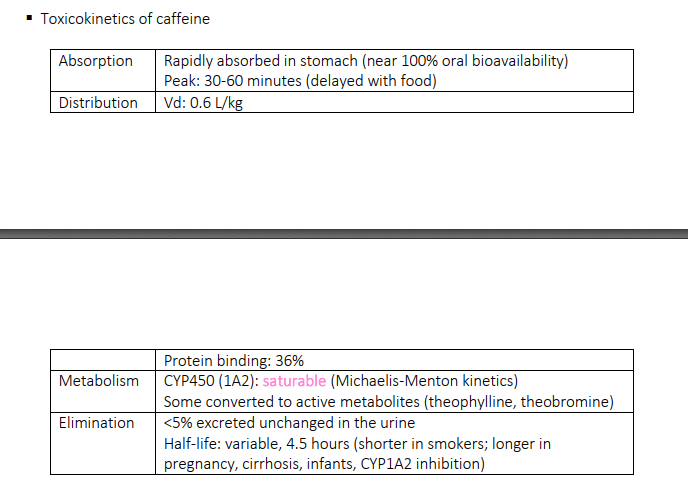
Bildverdeckung: nenne die verdeckten Beschriftungen
18
Bildverdeckung: nenne die verdeckten Beschriftungen
19
Bildverdeckung: nenne die verdeckten Beschriftungen
20
Bildverdeckung: nenne die verdeckten Beschriftungen
21
Bildverdeckung: nenne die verdeckten Beschriftungen
22
Bildverdeckung: nenne die verdeckten Beschriftungen
23
Bildverdeckung: nenne die verdeckten Beschriftungen
24
Bildverdeckung: nenne die verdeckten Beschriftungen
25
Bildverdeckung: nenne die verdeckten Beschriftungen
26
Bildverdeckung: nenne die verdeckten Beschriftungen
27
Bildverdeckung: nenne die verdeckten Beschriftungen
28
Bildverdeckung: nenne die verdeckten Beschriftungen
29
Clinical manifestations of caffiene toxicity
o Gastrointestinal: nausea; severe, intractable vomiting
o Cardiopulmonary: tachydysrhythmias, myocardial infarction, tachycardia, hypotension,
hyperventilation, respiratory failure
o Neurological: headache (cerebral vasoconstriction), agitation, hallucinations, seizures
o Musculoskeletal: tremor, fasciculation, hypertonicity, rhabdomyolysis
o Cardiopulmonary: tachydysrhythmias, myocardial infarction, tachycardia, hypotension,
hyperventilation, respiratory failure
o Neurological: headache (cerebral vasoconstriction), agitation, hallucinations, seizures
o Musculoskeletal: tremor, fasciculation, hypertonicity, rhabdomyolysis
30
Diagnosis of Caffeine Toxicity
o Vital signs
o EKG
o CMP (potassium)
o Serum caffeine concentration
o Immediately
o Every 1-2 hours until downward trend established
o CPK, urinalysis (rhabdomyolysis)
o EKG
o CMP (potassium)
o Serum caffeine concentration
o Immediately
o Every 1-2 hours until downward trend established
o CPK, urinalysis (rhabdomyolysis)
31
Treatment of Caffeine Toxicity
o ABCs
o GI decontamination: lavage (viable option unlike the others)
▪ Lavage: >50 mg/kg ingested + within 60 minutes of ingestion (NG > OG if liquid or
powder)
▪ Activated charcoal: potentially for solid dosage formulations
▪ Whole bowel irrigation: reasonable for sustained release formulations
o Symptomatic + supportive care
▪ Intractable vomiting: ondansetron (confirm QT interval first - hypokalemia),
metoclopramide
▪ Hypotension: IV fluids, vasopressors (phenylephrine>norepinephrine), beta-
blockers (esmolol, propranolol, metoprolol)
• Esmolol has very short t1/2 --> very easy to titrate to effect
▪ SVT: benzodiazepines + esmolol (adenosine + cardioversion will not work)
▪ Seizures: benzodiazepines > propofol or barbiturates (both will worsen
hypotension)
▪ Phenytoin + fosphenytoin are contraindicated
▪ Electrolyte repletion
▪ Hemodialysis indicated if: caffeine concentration >100 mg/L, seizures, life-
threatening dysrhythmias, shock
32
Clenbuterol
Found in: pre-workout supplements (lipolytic and anabolic effects)
33
Clenbuterol Mechanism of Toxicity
beta-2 adrenergic agonist
o Beta-2 adrenergic agonism → increase cAMP
▪ Relaxation of vascular, bronchial and uterine smooth muscle
▪ Glycogenolyses in skeletal muscle
▪ Hepatic glycogenolysis and gluconeogenesis
o Hypokalemia: influx of extracellular potassium into intracellular compartment
o Beta-2 adrenergic agonism → increase cAMP
▪ Relaxation of vascular, bronchial and uterine smooth muscle
▪ Glycogenolyses in skeletal muscle
▪ Hepatic glycogenolysis and gluconeogenesis
o Hypokalemia: influx of extracellular potassium into intracellular compartment
34
Toxicokinetics of Clebuterol
terminal half-life: 22 hours
35
Clinical manifestations of Clebuterol Toxicity
o Gastrointestinal: gastritis, vomiting
o Cardiovascular: tachycardia, atrial fibrillation, palpitations, chest pain, myocardial
infarction
o Electrolyte imbalance: hypokalemia, hypomagnesemia, hypophosphatemia
o Cardiovascular: tachycardia, atrial fibrillation, palpitations, chest pain, myocardial
infarction
o Electrolyte imbalance: hypokalemia, hypomagnesemia, hypophosphatemia
36
Diagnosis of Clebuterol Toxicity
o Vital signs
o EKG
o Troponin
o CMP (potassium)
o Magnesium
o Phosphate
o EKG
o Troponin
o CMP (potassium)
o Magnesium
o Phosphate
37
Treatment of Clebuterol Toxicity
o ABCs
o GI decontamination: Activated charcoal
o Management: symptomatic + supportive
o IV fluids
▪ Tachycardia: beta-blockers (esmolol [esmolol is preferred], propranolol,
metoprolol)
▪ Electrolyte repletion (careful)
▪ Once beta agonism resolves potassium will efflux from intracellular compartment
▪ Repleting too aggressively can lead to hyperkalemia upon toxicity resolution
38
Kratom
▪ Derived from Mitragyna speciosa
▪ More than 20 active components
o Mitragynine: most abundant
o 7-hydroxymitragynine: more potent (13x more potent vs. morphine)
▪ More than 20 active components
o Mitragynine: most abundant
o 7-hydroxymitragynine: more potent (13x more potent vs. morphine)
39
Kratom Mechanism of toxicity
agonists at opioid receptors, adrenergic, dopaminergic, serotonergic
o Dose dependent effects
▪ Low doses (1-5 g) = stimulant
▪ High doses (5-15 g) = opioid like
▪ Very high doses (>15 g) = sedation
o Dose dependent effects
▪ Low doses (1-5 g) = stimulant
▪ High doses (5-15 g) = opioid like
▪ Very high doses (>15 g) = sedation
40
Toxicokinetics of Kratom
o Onset of action: 5-10 minutes
o Duration: 1-1.5 hours
o Duration: 1-1.5 hours
41
Clinical manifestations of Kratom Toxicity
o Neurologic symptoms vary by dose
▪ Confusion, drowsiness, coma
▪ Agitation, psychosis, seizures
o Cardiovascular: tachycardia, arrhythmias
o Hepatic injury
▪ Cholestatic hepatitis pattern
▪ Elevated transaminases, alkaline phosphatase, total bilirubin
o Acute kidney injury
▪ Confusion, drowsiness, coma
▪ Agitation, psychosis, seizures
o Cardiovascular: tachycardia, arrhythmias
o Hepatic injury
▪ Cholestatic hepatitis pattern
▪ Elevated transaminases, alkaline phosphatase, total bilirubin
o Acute kidney injury
42
Treatment of Kratom Toxicity
o ABCs
o Symptomatic + supportive
▪ Seizures: benzodiazepines
o Symptomatic + supportive
▪ Seizures: benzodiazepines
43
Pennyroyal Oil
▪ Derived from the plant Mentha pulegium from the Labiatae family
▪ Found in many sources
o Flavoring and fragrance agents in food and cosmetics
o Flea repellants
o Tea brewed from leaves, oil, essence of pennyroyal (alcoholic preparation)
▪ Found in many sources
o Flavoring and fragrance agents in food and cosmetics
o Flea repellants
o Tea brewed from leaves, oil, essence of pennyroyal (alcoholic preparation)
44
Pennyroyal Oil Mechanism of Toxicity
o Primary active ingredient: pulegone (a monoterpene)
▪ Active isomer causes lung necrosis
▪ Decreases inward current from L-type calcium channels (myocardium)
▪ Blocks inward rectifying potassium channels (myocardium)
▪ Metabolized via CYP450 to menthofuran
• Causes centrilobular hepatic necrosis
• Depletes glutathione
▪ Active isomer causes lung necrosis
▪ Decreases inward current from L-type calcium channels (myocardium)
▪ Blocks inward rectifying potassium channels (myocardium)
▪ Metabolized via CYP450 to menthofuran
• Causes centrilobular hepatic necrosis
• Depletes glutathione
45
Clinical manifestations of Pennyroyal Oil Toxicity
o Gastrointestinal: nausea, vomiting, abdominal pain (within a few hours)
o Neurologic: dizziness, lethargy, seizures (with as little as 5 mL), coma
o Hepatic failure
o Renal failure
o Disseminated intravascular coagulopathy (DIC)
o Neurologic: dizziness, lethargy, seizures (with as little as 5 mL), coma
o Hepatic failure
o Renal failure
o Disseminated intravascular coagulopathy (DIC)
46
Treatment of Pennyroyal Oil Toxicity
o ABCs
o No role for GI decontamination
o Symptomatic + supportive
▪ Hepatotoxicity: N-acetylcysteine (Acetadote, Mucomyst)
▪ Seizures: benzodiazepines
o No role for GI decontamination
o Symptomatic + supportive
▪ Hepatotoxicity: N-acetylcysteine (Acetadote, Mucomyst)
▪ Seizures: benzodiazepines
Mehr Karteikarten: Medizin und Gesundheit
Neurons and Nervous System (Chapter 3)Medizin und Gesundheit · EnglischuzachihaTentafrågor:Medizin und Gesundheit · SchwedischAlilproChapter 8: PrefixesMedizin und Gesundheit · EnglischJulieSkull and Vertebral ColumnMedizin und Gesundheit · EnglischEshaBiology: Blood and the HeartMedizin und Gesundheit · EnglischNickMuscular SystemMedizin und Gesundheit · EnglischNotDisorders of Primary HemostasisMedizin und Gesundheit · EnglischCHRISTYHTNMedizin und Gesundheit · EnglischcathsimsHemacytometerMedizin und Gesundheit · EnglischJESSQTRANTop 250 Part 1Medizin und Gesundheit · Englischplane23BPA Practice 2023-24Medizin und Gesundheit · EnglischAl3.2.4 IMMUNITY CELLS AT WORKRKMedizin und Gesundheit · EnglischSabs2023
Alle Decks: Medizin und Gesundheit
Lerne diese Decks in der App
Kostenlos auf iPhone, Android, Mac und im Web. Füge jedes Deck mit einem Tipp zu deinem Konto hinzu.

